INWELT supplies plasma cutting torch accessories, consumables and replacement parts for manual, mechanized and CNC plasma cutting applications.
The product range is organized around the key components used in plasma torch assemblies, including electrodes, cutting nozzles, shields, retaining caps, swirl rings, gas diffusers, torch heads, handles, cable assemblies, connectors, adapters and cutting guides.
Plasma torch accessories should be selected according to the complete torch configuration rather than current rating alone. Torch model, consumable type, operating current, starting method, connection, gas system and application can all affect compatibility.
INWELT supports B2B customers including plasma equipment manufacturers, CNC cutting machine integrators, distributors, importers, wholesalers and industrial suppliers.
Plasma torch consumables work together as a complete front-end system. Each component has a specific function within the plasma arc, gas-flow and torch-protection system.
| Component | Main Function | Key Selection Factors |
|---|---|---|
| Electrode | Transfers electrical energy into the plasma arc | Torch model, current, electrode type |
| Nozzle / Tip | Constricts and directs the plasma arc | Current, bore size, torch family |
| Shield / Deflector | Protects the front-end assembly | Torch model, cutting process |
| Retaining Cap | Secures the consumable stack | Torch family, shield configuration |
| Swirl Ring | Controls plasma gas distribution | Torch model, gas system |
| Gas Diffuser | Distributes gas through the torch front end | Torch configuration |
| O-Ring | Provides sealing at applicable connections | Dimensions, material, torch model |
| Stand-Off Guide | Helps maintain torch-to-work distance | Torch and cutting application |
| Consumable Kit | Groups compatible replacement parts | Torch model and process |
The exact consumable structure varies between plasma torch families. Some systems use individual electrodes, nozzles, shields and swirl rings, while other designs may use integrated consumable configurations.
Always confirm the torch model and part number before ordering replacement components.
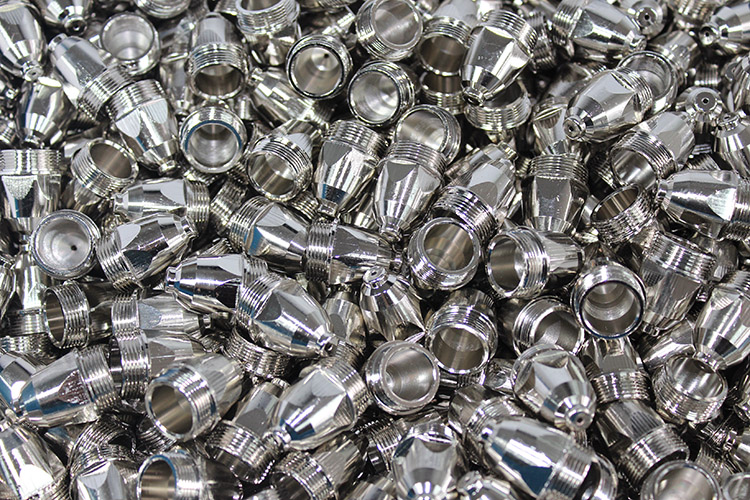
The plasma electrode transfers electrical energy into the plasma arc and operates under high thermal and electrical loads.
Electrodes are consumable components and gradually wear during plasma cutting.
Selection should consider:
Plasma torch model
Operating current
Starting method
Electrode design
Plasma gas
Cutting or gouging process
Manual or mechanized application
A worn electrode may contribute to unstable arc starting, reduced cutting consistency and accelerated wear of other consumable components.
Inspect the electrode for visible pitting, erosion, overheating or abnormal wear before continued operation.
The plasma nozzle, also called a cutting tip in some product systems, constricts and directs the plasma arc toward the workpiece.
Nozzle geometry and orifice size are closely related to the operating current and torch configuration.
INWELT plasma cutting nozzles can be organized according to:
Torch model
Current range
Nozzle bore
Standard or extended configuration
Contact or drag cutting
Gouging application
Manual or mechanized cutting
A nozzle should not be selected only because its physical dimensions appear compatible.
Incorrect nozzle selection can affect:
Arc concentration
Kerf width
Cut quality
Consumable wear
Arc stability
Inspect the nozzle regularly for an enlarged, distorted or damaged orifice.
Plasma shields, deflectors and retaining caps protect and position the torch front-end components.
Depending on the torch design, a plasma system may use:
Shield caps
Drag shields
Deflectors
Retaining caps
Gouging shields
Extended-reach front-end components
These components should be matched to the correct torch and consumable configuration.
For contact or drag cutting, the shield or drag component can also help maintain the intended relationship between the torch and workpiece.
For gouging and extended-reach applications, the front-end configuration may be different from standard cutting.
Do not substitute a shield or retaining cap solely based on external appearance.
A swirl ring or gas diffuser controls the flow of plasma gas around the electrode and toward the nozzle.
In applicable plasma torch designs, controlled gas distribution helps establish the required plasma arc and supports cooling of the front-end components.
When selecting a swirl ring or diffuser, confirm:
Torch model
Consumable family
Gas type
Gas-flow configuration
Current range
Component dimensions
A swirl ring with similar external dimensions may still have different internal passages and therefore should not be treated as a universal replacement.
Plasma torch maintenance may require replacement parts beyond standard consumables.
INWELT's plasma torch accessory category can include model-specific replacement components such as:
Torch heads
Handles
Trigger assemblies
Switch components
O-rings
Insulators
Positioning components
Cable supports
Connection components
Other torch repair parts
These components are useful for repairing or rebuilding plasma torch assemblies without replacing the complete torch.
For accurate replacement, customers should provide the torch model, existing part number, technical drawing or clear product photographs.
The torch head forms the front-end connection between the torch body and the consumable assembly.
Replacement torch heads may be required when the original head is mechanically damaged, overheated or no longer provides a reliable connection to the consumable system.
Other replaceable torch-body components can include:
Handles
Trigger switches
Trigger protection components
Springs
Joint components
Positioning tubes
Insulating parts
The correct replacement component depends on the specific torch design.
Manual torch components should not automatically be substituted for CNC or machine-torch components.
The cable assembly connects the plasma torch to the plasma power source and may carry power, gas, trigger signals, pilot-arc circuits or other control connections depending on the torch design.
Cable selection should consider:
Torch model
Cable length
Connector type
Control-wire configuration
Pilot-arc circuit
Gas connection
Manual or machine application
Common connection configurations may include:
Threaded connectors
Central adapters
Integrated connections
Separate control connections
Multi-pin connectors
Coaxial configurations
The connector should be matched to the plasma power source and torch wiring.
Two plasma torches with the same rated current may use different electrical and mechanical interfaces.
Plasma cutting guides help control torch positioning and cutting distance in selected applications.
Depending on the torch configuration, accessories may include:
Stand-off guides
Drag shields
Circle cutting guides
Cutting guide wheels
Positioning components
Torch spacers
The correct guide depends on the torch geometry and cutting application.
Manual and CNC cutting systems may require different methods of controlling torch-to-work distance.
Consumable kits group multiple compatible replacement components into a convenient package.
A plasma consumable kit may include combinations of:
Electrodes
Cutting nozzles
Shields
Retaining caps
Swirl rings
O-rings
Gouging components
Other torch-specific parts
For distributors and aftermarket suppliers, model-specific kits can simplify inventory management and replacement ordering.
For OEM customers, kit contents can be evaluated according to the required torch model, current range, consumable configuration and packaging requirements.
Plasma torch accessories should be organized by torch family to make replacement-part identification easier.
INWELT's plasma torch portfolio includes multiple manual and CNC/mechanized torch families, including LT, PT, PANA and PMX configurations.
Each torch family can have its own:
Electrode
Cutting nozzle
Shield
Retaining component
Swirl ring
Torch head
Cable assembly
Connector
Adapter
Replacement kit
For example, the PT Series includes both manual PT models and CNC-oriented PTM models, while the LT Series includes manual LT and machine-oriented LTM configurations.
The complete torch and its accessories should always be identified by the specific model rather than by series name alone.
Manual and mechanized plasma cutting applications can require different torch components.
Manual cutting may require:
Torch handle components
Trigger assemblies
Drag shields
Stand-off guides
Cutting nozzles
Electrodes
Cable assemblies
Machine-torch configurations may require:
Machine torch heads
Positioning tubes
Mounting components
Central adapters
Control cables
Mechanized consumables
Torch-height-control-related interfaces
A manual torch and a machine torch should not be considered interchangeable simply because they have the same current rating.
Correct selection starts with identifying the complete torch configuration.
Confirm the exact torch model and series.
Examples may include:
LT
LTM
PT
PTM
PANA
PMX
PMX-M
Other supported plasma torch configurations
The current rating helps identify the appropriate consumable range, but it should not be used as the only compatibility criterion.
Different torch models can operate at similar current levels while using different consumable dimensions and connection systems.
Plasma torches can use different starting architectures.
Depending on the torch and plasma power source, the system may use:
HF starting
Blowback / back-striking
Pilot-arc configurations
Other manufacturer-specific starting methods
The starting system must match the plasma power source.
Confirm the relationship between:
Electrode
Nozzle
Shield
Retaining cap
Swirl ring
Gas diffuser
These components often form a matched consumable system.
For a complete torch or cable replacement, confirm:
Rear connector
Thread specification
Central adapter
Pin configuration
Control wiring
Pilot-arc connection
Gas connection
Identify whether the torch is intended for:
Manual cutting
Mechanized cutting
CNC cutting
Other automated applications
The complete torch configuration should match the intended installation.
Current rating alone is not sufficient to determine plasma torch compatibility.
Use the following checklist:
| Compatibility Factor | Information to Confirm |
|---|---|
| Torch Model | Exact model and series |
| Torch Type | Manual / Machine / CNC |
| Current | Operating current |
| Starting Method | HF / Back-Striking / Pilot Arc |
| Electrode | Correct electrode type |
| Nozzle | Correct bore and current |
| Shield | Matching front-end configuration |
| Retaining Cap | Matching consumable system |
| Swirl Ring | Matching gas-distribution system |
| Gas | Air / N₂ / Other specified gas |
| Connector | Thread or central connection |
| Control Wiring | Number and configuration of wires |
| Cable Length | Required lead length |
| Application | Cutting / Gouging / Contact Cutting |
For replacement projects, sending the existing torch model, part number and connector photographs is recommended.
Plasma consumable life depends on actual operating conditions.
Important factors include:
Cutting current
Material
Material thickness
Piercing frequency
Cutting speed
Torch height
Gas quality
Gas pressure
Starting method
Consumable condition
There is no universal replacement interval that applies to every plasma torch.
Regular inspection is recommended.
Check for:
Excessive pitting
Uneven erosion
Cracking
Abnormal discoloration
Check for:
Enlarged or distorted orifice
Arc marks
Heavy spatter
Irregular wear
Check for:
Cracks
Melting
Deformation
Excessive spatter
Check for:
Cracks
Blocked gas passages
Damaged sealing areas
Deformation
Replacing worn consumables before they affect the complete torch assembly can help reduce unexpected downtime.
Check:
Nozzle condition
Electrode condition
Cutting current
Torch height
Travel speed
Gas pressure
Gas quality
Check:
Electrode condition
Nozzle condition
Starting method
Pilot-arc circuit
Cable connection
Gas supply
Check:
Correct nozzle for current
Torch-to-work distance
Piercing procedure
Consumable installation
Electrode condition
Gas supply
Check:
Cutting speed
Cutting current
Torch height
Nozzle condition
Gas pressure
Material
Check:
O-rings
Torch connections
Gas fittings
Retaining components
Damaged sealing surfaces
Do not replace multiple components without first identifying the likely cause of the problem.
INWELT supplies plasma torch accessories and replacement components for B2B customers including:
Plasma cutter manufacturers
Welding and cutting equipment manufacturers
CNC plasma machine manufacturers
Plasma torch brands
CNC integrators
Importers
Distributors
Wholesalers
Industrial suppliers
Aftermarket parts companies
The product range can support both complete torch programs and replacement-part supply.
For distributors, model-specific accessories and consumables can help build a structured aftermarket product portfolio.
INWELT supports OEM and ODM projects for plasma torch accessories and consumables.
Depending on the product and project requirements, options may include:
Private-label packaging
Customer branding
Product labels
Customer part numbers
Cable length
Connector configuration
Consumable configuration
Consumable kits
Bulk packaging
Barcode and carton requirements
For OEM projects, customers can provide an original part number, technical drawing, physical sample or product photographs for technical evaluation.
Plasma torch accessories include consumables and replacement components used with plasma cutting torches. Common examples include electrodes, nozzles, shields, retaining caps, swirl rings, torch heads, cables, connectors and cutting guides.
Plasma torch consumables are wear components that are gradually consumed during plasma cutting. Electrodes, nozzles, shields and swirl rings are common examples.
The electrode transfers electrical energy into the plasma arc, while the nozzle constricts and directs the plasma jet toward the workpiece.
A swirl ring controls plasma gas distribution around the electrode and toward the nozzle in applicable torch designs.
A shield or deflector helps protect the torch front-end components from heat, spatter and contact with the workpiece, depending on the torch configuration.
No.
Current rating is important, but torch model, starting method, consumable design, connector and gas system also need to match.
Not automatically.
Compatibility should be confirmed by torch model, part number, dimensions and complete consumable configuration.
Some consumables may share a component family, but complete torch assemblies and machine interfaces can be different.
Always confirm the exact model and application.
INWELT can supply model-specific plasma torch consumables and replacement components according to the available product configuration.
Yes. INWELT supports OEM/ODM and private-label projects for qualified B2B customers according to product specifications, packaging requirements and order quantities.
Mixed-product orders can be evaluated according to torch models, part numbers, quantities, packaging requirements and target market.
To help us identify the correct plasma torch accessories, please provide:
Plasma torch model
Plasma cutter model
Torch type
Operating current
Starting method
Consumable type
Existing part number
Electrode specification
Nozzle specification
Shield or retaining cap
Swirl ring or gas diffuser
Connector type
Cable length
Application
Required quantity
OEM or private-label requirements
If the exact part number is unknown, send clear photographs of the plasma torch, consumable assembly and rear connector.
INWELT can evaluate the required configuration and provide a suitable plasma torch accessory, consumable or replacement-part solution for your B2B application.