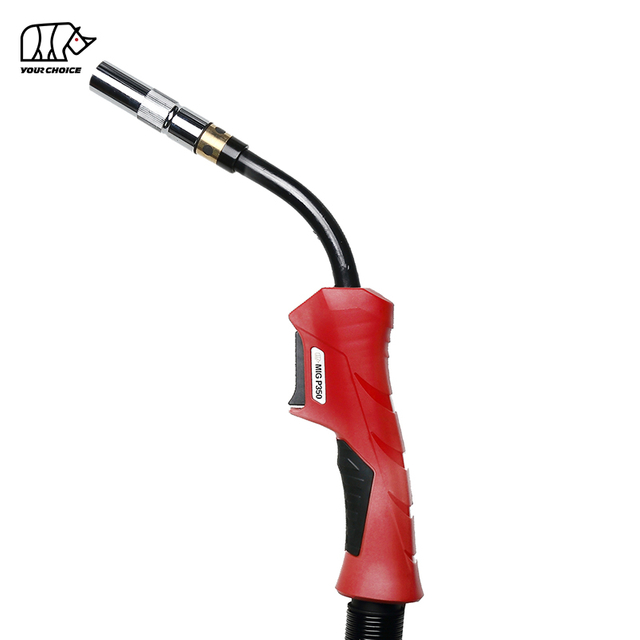
PANA Series MIG Welding Torches for Manual and Robotic Welding
INWELT PANA Series is a family of gas-cooled MIG/MAG welding torches covering manual welding and automated robotic welding applications.
The range includes:
P180 for lower-current manual fabrication
P350 for medium- to heavy-duty production welding
P500 for high-current industrial MIG/MAG welding
350D Robot Torch for automated and robotic welding cells
This product structure allows welding equipment distributors and industrial users to select a torch according to welding current, wire diameter, duty cycle, cable requirements and whether the process is manual or automated.
PANA-style replacement consumables and components are also available, allowing buyers to source complete torches together with contact tips, gas nozzles, liners, torch heads, handles and cable assemblies.
The P180 is the most compact manual model in the INWELT PANA range.
The INWELT configuration is rated at:
200A with CO₂ shielding gas
160A with mixed gas
60% duty cycle
Ø0.8–1.2 mm welding wire
3 m / 4 m / 5 m cable options
Gas-cooled construction
The P180 is suited to welding applications where maneuverability and a relatively compact torch are important.
Typical uses include:
Light metal fabrication
Automotive repair
Sheet-metal work
General workshops
Maintenance
Small machinery
Furniture and light structural fabrication
For distributors, the P180 provides an entry-level model within the PANA family while sharing the same overall consumable-supply concept as the higher-current models.
The P500 is the highest-current manual torch currently listed in the INWELT PANA Series.
The current specification includes:
500A with CO₂
450A with mixed shielding gas
60% duty cycle
Ø0.8–1.6 mm welding wire
3 m / 4 m / 5 m cable options
Gas / air-cooled construction
The P500 is designed for applications where higher welding current and deposition rates are required without moving to a water-cooled torch platform.
Typical uses include:
Heavy structural fabrication
Shipbuilding
Heavy machinery
Mining and construction equipment
Large steel assemblies
High-deposition production welding
Industrial repair
Because higher welding current places greater thermal load on the front-end components, correct contact-tip, nozzle and cable selection becomes increasingly important at P500 operating levels.
The 350D extends the PANA Series from manual welding into automated and robotic MIG/MAG production.
The INWELT 350D is an air-cooled robotic torch specified at:
350A with CO₂
280A with mixed gas
60% duty cycle
Ø0.8–1.2 mm welding wire
Customizable cable length
Replaceable torch neck
31° and 45° neck options
PANA / EURO interface configurations
Unlike P180, P350 and P500, the 350D is designed primarily for integration into robotic or automated welding cells rather than hand-held operator use.
Its replaceable-neck construction can simplify maintenance when the torch neck becomes worn or damaged.
Different neck-angle and mounting configurations can also help system integrators optimize torch access for specific fixtures and weld-joint geometries.
Typical applications include:
Automotive production
Robotic fabrication cells
Repetitive component welding
Metal furniture production
Machinery manufacturing
Automated structural assemblies
High-volume MIG/MAG welding
P180 vs. P350 vs. P500 vs. 350D: Which PANA MIG Torch Should You Choose?
Model
Operation
CO₂ Rating
Mixed Gas Rating
Duty Cycle
Wire Range
Cable
P180
Manual
200A
160A
60%
Ø0.8–1.2 mm
3 / 4 / 5 m
P350
Manual
340A
320A
60%
Ø0.8–1.6 mm
3 / 4 / 5 m
P500
Manual
500A
450A
60%
Ø0.8–1.6 mm
3 / 4 / 5 m
350D
Robotic / Automated
350A
280A
60%
Ø0.8–1.2 mm
Custom
Choose P180 When:
Lower welding current is sufficient
A lighter manual torch is preferred
Ø0.8–1.2 mm wire covers the application
General fabrication and repair are the main workloads
Choose P350 When:
More current capacity is required
Ø0.8–1.6 mm wire flexibility is useful
Medium- to heavy-duty fabrication is common
One versatile industrial manual torch is required
Choose P500 When:
High-current manual welding is required
Heavy fabrication is the primary application
Larger components and higher deposition rates are common
A 500A-class gas-cooled torch matches the welding procedure
Choose 350D When:
Welding is robotic or automated
Repeatability and torch mounting are more important than handheld ergonomics
Replaceable torch necks are preferred
Custom cable length or neck-angle configuration is required
Manual MIG Torch vs. Robotic MIG Torch
P180, P350 and P500 are designed primarily for manual welding, while 350D is designed for robotic and automated installations.
Manual PANA MIG Torches
Manual welding guns include a handle and trigger so the welder can control:
Torch angle
Travel direction
Arc position
Wire placement
Working distance
They are appropriate for variable fabrication where operators regularly move between different weld joints.
350D Robotic MIG Torch
A robot torch operates as part of an automated system.
Instead of being held by a welder, the torch is mounted to a robot or automation fixture.
Important selection factors therefore include:
Torch-neck geometry
Mounting system
Cable routing
Robot working envelope
TCP consistency
Consumable accessibility
Maintenance time
Collision recovery strategy
The best robotic torch configuration should be confirmed with the robotic cell design and welding procedure.
How to Select the Correct PANA MIG Welding Torch
Selecting a MIG torch only by model name can lead to an incorrect configuration.
Professional buyers should evaluate several factors.
Welding Current
Start with the actual welding current used in production.
Choose a torch whose rated capacity and duty cycle match the welding procedure.
For example, moving from P180 to P350 or P500 is appropriate when the normal welding load requires additional current capacity.
Shielding Gas
Torch ratings can differ between:
100% CO₂
Argon/CO₂ mixed shielding gas
Always compare the correct gas rating rather than relying on one maximum amperage number.
Wire Diameter
The wire-feeding system—including contact tip and liner—must match the welding wire.
Current INWELT configurations cover:
P180: Ø0.8–1.2 mm
P350: Ø0.8–1.6 mm
P500: Ø0.8–1.6 mm
350D: Ø0.8–1.2 mm
Cable Length
Manual PANA torches are available in standard 3 m, 4 m and 5 m configurations.
Choose a cable long enough for the workstation without adding unnecessary weight and drag.
The 350D robotic torch can be configured according to the layout of the automated welding cell.
Welding Machine Connection
Always confirm:
Power connection
Gas connection
Trigger wiring
Central connection
Machine interface
Do not assume that every PANA-style torch will connect directly to every MIG/MAG welding machine.
PANA MIG Torch Consumables and Replacement Parts
Consumable availability is an important consideration for distributors and industrial welding operations.
INWELT supplies replacement components across the PANA family.
MIG Contact Tips
Contact tips transfer welding current to the wire immediately before the arc.
INWELT supplies PANA-style contact tips for P180, P350 and P500 in materials including:
E-Cu
CuCrZr
Available dimensions and wire bores vary according to the torch platform.
Correct contact-tip selection helps maintain:
Stable electrical contact
Smooth wire feeding
Predictable arc characteristics
Appropriate service life
Gas Nozzles
The nozzle directs shielding gas around the welding arc and protects the front-end components.
PANA-style nozzles are available for P180, P350 and P500 configurations.
Different geometries may be selected according to joint access and welding requirements.
Gas Diffusers and Tip Holders
The diffuser supports the contact tip and distributes shielding gas through the front end of the torch.
Correctly matched diffusers are important for both mechanical alignment and gas coverage.
Wire Liners
The liner guides the welding wire through the torch cable.
Choose the liner according to:
Wire diameter
Wire material
Torch length
Welding application
A worn or incorrectly selected liner can contribute to feeding resistance and unstable welding.
Torch Heads, Handles and Cable Assemblies
INWELT can also supply service components such as:
Torch heads
Handles
Trigger switches
Cable assemblies
Rear connections
Support springs
For B2B customers, complete torch-and-consumable packages can simplify purchasing and aftermarket support.
Why PANA Consumable Compatibility Matters for Distributors
A MIG torch generates repeat sales through its replacement components.
For distributors, it is therefore important to evaluate the complete product ecosystem rather than the torch alone.
A well-planned PANA inventory can include:
P180 / P350 / P500 complete torches
350D robotic torches and neck components
Contact tips
Gas nozzles
Diffusers
Liners
Torch heads
Cable assemblies
Switches
Repair components
This helps customers continue operating the torch after consumables begin to wear.
It also allows distributors to develop an aftermarket consumable program around the installed torch base.
Applications for PANA Series MIG Welding Torches
The four PANA models cover a broad range of manual and automated MIG/MAG welding applications.
Typical industries include:
Automotive manufacturing
Structural steel fabrication
Machinery production
Agricultural equipment
Truck and trailer manufacturing
Shipbuilding
Construction equipment
Metal furniture
General fabrication
Industrial maintenance
Robotic welding cells
Automated production lines
Torch selection should still be based on the actual current, duty cycle, wire and production environment rather than the industry name alone.
PANA Series for MIG/MAG and FCAW Applications
PANA-style torch platforms are primarily used in MIG/MAG welding.
Depending on the wire, liner, contact-tip configuration and welding power source, suitable torch assemblies can also be used in applicable gas-shielded flux-cored welding operations.
The welding procedure should determine:
Wire type
Wire diameter
Shielding gas
Welding current
Contact tip
Liner
Torch capacity
For specialized wire applications, confirm the required configuration with INWELT before ordering.
PANA MIG Welding Torch Manufacturer for OEM and Wholesale Supply
INWELT supplies MIG welding torches and replacement components to professional B2B customers including:
Welding equipment manufacturers
Welding-machine brands
Importers
Distributors
Wholesalers
Industrial supply companies
Robotic welding integrators
Private-label welding brands
Customers can source a single PANA model or build a broader torch range covering light, medium, heavy and automated welding.
OEM and Private-Label PANA MIG Torch Options
Qualified OEM and ODM projects can be configured according to customer and market requirements.
Customization may include:
Brand logo
Product labeling
Handle appearance
Packaging
Cable length
Connection interface
Consumable kits
Instruction manuals
Bulk cartons
Barcode requirements
350D robotic cable configuration
Robot torch neck options
For OEM development, provide the welding-machine specification, target current range, wire size, connection interface and expected order quantity.
Quality Control for PANA MIG Welding Torches
For professional B2B buyers, quality consistency is particularly important because the torch includes electrical, gas, wire-feeding and mechanical components in one assembly.
Relevant production checks can include:
Dimensional inspection
Cable assembly inspection
Electrical continuity
Insulation
Gas flow
Trigger function
Connector fit
Contact-tip fit
Liner installation
Final torch assembly
For robotic 350D projects, mounting dimensions and torch-neck configuration should also be confirmed before volume production.
Frequently Asked Questions About PANA MIG Welding Torches
What models are included in the INWELT PANA Series?
The current INWELT MIG range includes P180, P350, P500 and 350D robotic MIG welding torch configurations.
What is the difference between P180, P350 and P500?
The main differences are welding-current capacity and wire range.
P180 is the lower-current manual model, P350 covers medium- to heavy-duty welding, and P500 provides the highest current capacity for heavy industrial manual welding.
Which PANA torch is best for general fabrication?
P350 provides a useful balance between current capacity and wire range for many general industrial fabrication applications.
The final choice should still be based on the actual welding procedure.
Which PANA torch should I use for heavy welding?
P500 is the highest-current manual model in the current INWELT PANA range.
It is specified for 500A with CO₂ and 450A with mixed gas at a 60% duty cycle.
What is the 350D MIG torch used for?
The 350D is intended for robotic and automated MIG/MAG welding rather than conventional handheld welding.
It uses a replaceable torch neck and can be configured for robotic cell requirements.
Is the 350D the same as the P350?
No.
Although both operate in a similar current class, P350 is primarily a manual MIG welding torch while 350D is designed for automated and robotic installations.
Are PANA Series torches air cooled?
The P180, P350, P500 and current 350D models listed in this category are gas/air cooled.
What cable lengths are available?
P180, P350 and P500 are available in standard 3 m, 4 m and 5 m configurations.
350D cable length can be configured according to the robotic welding system.
What wire sizes are supported?
Current INWELT specifications list:
P180: Ø0.8–1.2 mm
P350: Ø0.8–1.6 mm
P500: Ø0.8–1.6 mm
350D: Ø0.8–1.2 mm
Does INWELT supply replacement consumables?
Yes.
INWELT supplies PANA-style contact tips, nozzles and other replacement components together with complete torch assemblies.
Can INWELT supply OEM or private-label PANA MIG torches?
Yes.
OEM/ODM services can include branding, packaging, cable and connector configurations, consumable kits and product labeling for qualified B2B projects.
Can I use an INWELT PANA torch on any MIG welder?
Not automatically.
The current rating, connection, trigger wiring and machine interface should be checked before ordering.
For replacement projects, provide the MIG welding-machine model and photographs of the existing torch connection.
Request a Quote for PANA Series MIG Welding Torches
Looking for P180, P350, P500 manual welding torches, a 350D robotic MIG torch, replacement consumables or an OEM welding torch supplier?
For faster configuration confirmation, provide:
MIG/MAG welding-machine brand and model
Manual or robotic application
Normal welding current
CO₂ or mixed shielding gas
Welding wire diameter
Required cable length
Torch connection
Consumable requirements
Estimated quantity
INWELT or private-label branding
INWELT can then recommend the most appropriate PANA torch and consumable configuration for your welding application.
This website uses cookies and similar technologies (“cookies”). Subject to your consent, will use analytical cookies to track which content interests you, and marketing cookies to display interest-based advertising. We use third-party providers for these measures, who may also use the data for their own purposes.
You give your consent by clicking "Accept all" or by applying your individual settings. Your data may then also be processed in third countries outside the EU, such as the US, which do not have a corresponding level of data protection and where, in particular, access by local authorities may not be effectively prevented. You can revoke your consent with immediate effect at any time. If you click on "Reject all", only strictly necessary cookies will be used.
 English
 简体中文
简体中文 العربية
 Français
 Русский
 Español
 Português
 Deutsch
 italiano
 日本語
日本語 한국어
한국어 Nederlands
 Tiếng Việt
 ไทย
ไทย Polski
 Türkçe
 ភាសាខ្មែរ
 Bahasa Melayu
 Filipino
 Bahasa Indonesia
 magyar
 Română
 Čeština
 Монгол
 қазақ
қазақ Српски
 हिन्दी
 فارسی
فارسی Slovenčina
 Slovenščina
 Norsk
Norsk Svenska
 українська
 Ελληνικά
 Suomi
Suomi Latine
 Dansk
Dansk বাংলা
বাংলা Hrvatski
 Afrikaans
 Gaeilge
 Eesti keel
 नेपाली
 Oʻzbekcha
 latviešu
 Azərbaycan dili
 Беларуская мова
 Bosanski
 Български
 ქართული
 Lietuvių