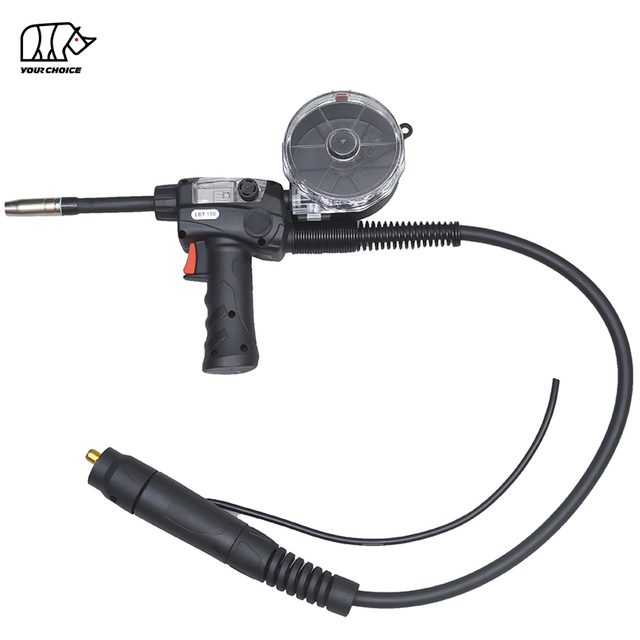
Although all three products are intended primarily for aluminum MIG welding and other applications requiring reliable wire feeding, the wire-feed architecture is different.
LB150 and L250 carry the wire supply close to the welding gun, while LPA300 uses a push-pull feeding system designed for longer cable lengths.
INWELT Aluminum MIG Gun Comparison
Model
Gun Type
Current INWELT Rating
Duty Cycle
Wire Size
Cable Length
LB150
Spool Gun
150A CO₂ / 130A Mixed Gas
60%
0.8–1.0 mm
3 / 4 / 6 / 8 m
LB250
Spool Gun
200A CO₂ / 180A Mixed Gas
60%
0.8–1.2 mm
3 / 4 / 6 / 8 m
LPA300
Push-Pull Gun
300A CO₂ / 270A Mixed Gas
60%
1.2–1.6 mm
6 / 8 / 10 / 12 m
The CO₂ and mixed-gas values above are current INWELT torch-rating data.
They should not be interpreted as shielding-gas recommendations for aluminum MIG welding.
For aluminum MIG welding, use the shielding gas specified by the welding procedure and filler-wire manufacturer. Pure argon is the most common choice for many aluminum MIG applications.
LB150 150A MIG Spool Gun
The INWELT LB150 is a compact gas-cooled MIG spool gun designed primarily for reliable feeding of smaller-diameter soft welding wires.
Current INWELT specifications include:
150A CO₂ torch rating
130A mixed-gas torch rating
60% duty cycle
0.8–1.0 mm wire range
Gas-cooled construction
3 m / 4 m / 6 m / 8 m cable options
Integrated wire-spool feeding mechanism
Replaceable contact tip and gas nozzle
OEM customization available
The LB150 is particularly suitable for applications where a shorter wire-feed path is beneficial.
Typical applications include:
Aluminum automotive repair
Light fabrication
Aluminum frames
Marine repair
General workshop welding
Maintenance applications
LB250 200A MIG Spool Gun
The LB250 provides additional current and wire-size capacity compared with the LB150.
Current INWELT specifications include:
200A CO₂ torch rating
180A mixed-gas torch rating
60% duty cycle
0.8–1.2 mm wire range
Gas-cooled construction
3 m / 4 m / 6 m / 8 m cable options
Integrated spool-gun feeding system
Replaceable M6 contact-tip system
Gas diffuser and nozzle
OEM/ODM options
The LB250 is suited to medium-duty aluminum fabrication where a larger wire range or higher current capacity is required.
Typical applications include:
Aluminum trailer fabrication
Marine fabrication
Transportation equipment
General aluminum structures
Industrial maintenance
Medium-duty fabrication
LPA300 300A Push-Pull MIG Welding Gun
The INWELT LPA300 is different from the LB150 and LB250 because it uses a push-pull wire-feeding system rather than carrying the complete welding-wire spool directly on the gun.
Current INWELT specifications include:
300A CO₂ torch rating
270A mixed-gas torch rating
60% duty cycle
1.2–1.6 mm welding wire
Air-cooled construction
6 m / 8 m / 10 m / 12 m cable options
Push-pull wire-feeding architecture
Gun-mounted wire-speed control
Euro-style rear connection on the current configuration
OEM customization available
The LPA300 is designed for professional aluminum welding applications where long cable reach and reliable feeding of soft wire are important.
Typical applications include:
Aluminum structures
Shipbuilding
Rail vehicles
Trailers and trucks
Transportation equipment
Heavy aluminum fabrication
Industrial manufacturing
Spool Gun vs. Push-Pull Gun: What Is the Difference?
Spool guns and push-pull guns solve the same basic problem in different ways.
Soft aluminum wire can buckle or birdnest when pushed through a long conventional MIG gun cable.
Spool Gun
A spool gun positions a small welding-wire spool directly on or very close to the welding gun.
This creates a short feeding path between the wire supply and the contact tip.
Advantages can include:
Short wire-feed path
Reduced feeding resistance
Reduced risk of birdnesting
Simple aluminum-wire setup
Compact integrated feed mechanism
Current INWELT examples:
LB150
LB250
Push-Pull Gun
A push-pull gun uses coordinated wire-feeding force from both the main wire feeder and a motor in the welding gun.
This architecture is particularly useful for longer gun cables.
Advantages can include:
Longer working reach
Stable feeding over longer cable lengths
Larger central wire supply
Professional production use
Reduced soft-wire feeding resistance
Current INWELT example:
LPA300
Which Aluminum MIG Gun Should I Choose?
The correct gun depends on the welding application, current, wire diameter, cable length and welding-machine interface.
Choose LB150 When
You require:
Up to the current LB150 current class
0.8–1.0 mm wire
Compact spool-gun construction
Light- to medium-duty aluminum welding
Choose LB250 When
You require:
Higher current than LB150
0.8–1.2 mm wire
Spool-gun feeding
Medium-duty aluminum fabrication
Choose LPA300 When
You require:
Higher current capacity
1.2–1.6 mm wire
Long 6–12 m cable options
Push-pull wire feeding
Professional production or large fabrication work
Why Aluminum Wire Is More Difficult to Feed
Aluminum welding wire is softer than typical carbon-steel MIG wire.
Because of its lower column strength, soft wire is more likely to deform when pushed through a long cable.
Potential feeding problems include:
Birdnesting
Wire buckling
Irregular wire speed
Contact-tip burnback
Arc instability
A spool gun shortens the feeding path.
A push-pull system adds controlled feeding force at the gun while the main feeder pushes from the rear.
Both systems can improve wire-feeding reliability when correctly configured.
Aluminum MIG Wire Sizes for INWELT Spool and Push-Pull Guns
The current INWELT range covers approximately:
0.8 mm
0.9 mm
1.0 mm
1.2 mm
1.4 mm
1.6 mm
Model-specific ranges are:
Model
Current Wire Range
LB150
0.8–1.0 mm
LB250
0.8–1.2 mm
LPA300
1.2–1.6 mm
Always select the contact tip, drive components and gun setup for the actual filler-wire diameter.
4043 vs. 5356 Aluminum Welding Wire
Two common aluminum MIG filler families are 4043 and 5356.
The correct filler alloy depends on:
Base-metal alloy
Required mechanical properties
Corrosion requirements
Welding procedure
Service environment
Post-weld finishing requirements
Do not choose filler wire solely according to the spool gun model.
The welding procedure and filler-metal manufacturer's recommendations should determine the final wire selection.
What Shielding Gas Should Be Used for Aluminum MIG Welding?
For many aluminum MIG welding applications, 100% argon is the most commonly used shielding gas.
Argon/helium mixtures may also be used for selected applications where additional heat input or penetration characteristics are required.
Avoid assuming that the CO₂ or mixed-gas current rating printed for a MIG gun means that CO₂ should be used for aluminum welding.
Torch current ratings and welding-process shielding-gas recommendations are different specifications.
Always follow the approved welding procedure.
Why CO₂ Mixtures Should Not Be Used as the Default Aluminum MIG Gas
CO₂-containing mixtures commonly used for carbon-steel MIG welding are not the standard shielding-gas choice for aluminum.
For aluminum MIG welding, use:
100% argon for many common applications
Appropriate argon/helium mixtures where required by the procedure
Use the filler-wire and welding-machine manufacturer's recommendations when selecting gas.
Spool Gun Current Rating and Duty Cycle
Current capacity and duty cycle should always be considered together.
The current INWELT range includes 60% duty-cycle configurations.
A 60% duty cycle does not mean that the gun can weld continuously at its rated current without interruption.
Actual thermal loading depends on:
Welding current
Arc-on time
Shielding gas
Ambient temperature
Cable condition
Contact-tip condition
Welding procedure
Do not operate a welding gun above its verified current and duty-cycle limits.
Cable Length and Wire Feeding
Cable length is especially important when welding aluminum.
Current INWELT options include:
LB150
3 m
4 m
6 m
8 m
LB250
3 m
4 m
6 m
8 m
LPA300
6 m
8 m
10 m
12 m
The longer cable options of the LPA300 are one reason a push-pull architecture is useful for larger work areas.
Welding Machine Compatibility
A spool gun or push-pull gun should not be selected only because the welding machine has a similar amperage rating.
Compatibility depends on several factors.
Confirm:
Welding power-source type
Output current
Gun connector
Trigger/control signals
Motor-control voltage
Wire-speed control
Gas connection
Feeder/control-box requirements
Some welding machines support direct spool-gun connection.
Others require:
An adapter
A dedicated control box
A specific multi-pin connector
A compatible wire feeder
Do not describe a spool gun as universally plug-and-play unless the exact machine interface has been verified.
Spool Gun Connector and Control Interface
The rear connection carries more than welding current.
Depending on the configuration, it can also provide:
Trigger control
Gun motor power
Wire-speed control
Gas connection
Additional control signals
For replacement and OEM orders, provide:
Welding machine brand
Machine model
Existing gun model
Connector photograph
Connector pin count
Control voltage if known
Required cable length
This allows INWELT to evaluate the correct interface.
Push-Pull Gun System Compatibility
A push-pull gun is normally part of a complete wire-feeding system.
The gun motor must operate in coordination with the main wire feeder.
Before installing the LPA300, confirm:
Main wire feeder
Push-pull control method
Motor voltage
Wire-speed control
Rear connector
Trigger signals
Cable length
Wire diameter
A Euro-style mechanical connector alone does not guarantee full push-pull system compatibility.
Spool Gun Wire Spool Capacity
Spool capacity is an important selection parameter for a true spool gun.
INWELT should publish the verified spool specifications for LB150 and LB250, including:
Maximum spool diameter
Maximum spool weight
Spool shaft dimensions
Wire-package compatibility
Spool cover dimensions
This information helps buyers compare LB150 and LB250 with other professional spool-gun systems.
Do not copy another manufacturer's spool dimensions.
Publish measured INWELT data.
Wire Feed Speed and Gun Motor Specifications
Wire-feed speed is another important first-party specification for aluminum MIG guns.
For LB150, LB250 and LPA300, INWELT should publish verified data for:
Wire-feed speed range
Feed-motor voltage
Motor power
Drive-roll type
Drive-roll diameter
Tension adjustment
Wire-speed adjustment range
These specifications are particularly valuable for:
Welding machine manufacturers
OEM projects
System integrators
Repair companies
Professional distributors
Drive Rolls and Wire Feeding Components
The drive system should be selected for the actual wire type and gun architecture.
Do not use one universal drive-roll recommendation for every spool gun or push-pull gun.
Depending on the design, feeding components may include:
Drive roll
Idler roll
Inlet guide
Wire guide
Tension mechanism
Gun motor
Spool hub
Inspect these components if wire feeding becomes unstable.
Contact Tips for Aluminum MIG Spool Guns
The contact tip guides the welding wire and transfers welding current.
Select the contact tip according to:
Wire diameter
Wire alloy
Contact-tip thread
Torch model
Welding current
Current INWELT examples include M6 contact-tip systems on LB150 and LB250.
A worn contact tip can contribute to:
Arc instability
Burnback
Poor electrical contact
Irregular wire feeding
Replace the contact tip according to actual wear.
Gas Nozzles and Diffusers
The gas nozzle directs shielding gas around the arc and molten weld pool.
The diffuser distributes shielding gas through the torch front end.
Inspect for:
Spatter accumulation
Blocked gas holes
Mechanical damage
Heat damage
Loose threads
Correct shielding-gas coverage is particularly important when MIG welding aluminum because aluminum welds are sensitive to contamination and porosity.
Spool Gun Liners and Wire Guides
Because spool guns place the wire supply close to the torch, the wire path is shorter than in a conventional MIG gun.
However, short liners and wire guides still need to be correctly selected and maintained.
Check for:
Contamination
Burrs
Incorrect internal diameter
Mechanical wear
Misalignment
Do not automatically use a steel-wire liner recommendation for every aluminum-wire configuration.
What Materials Can Be Welded with a Spool Gun?
Spool guns are most commonly associated with aluminum MIG welding because they help feed soft aluminum wire.
Depending on the gun, power source, wire and consumables, a spool gun can potentially feed other welding wires.
However, for conventional carbon-steel welding, a standard MIG gun is often the simpler and more economical solution.
The primary positioning of the INWELT Spool Gun category should therefore remain:
Aluminum MIG welding and soft-wire feeding applications.
Typical Aluminum Spool Gun Applications
INWELT spool and push-pull welding guns can support applications including:
Aluminum automotive repair
Trailer manufacturing
Truck bodies
Marine fabrication
Boat construction and repair
Railway equipment
Aluminum tanks and frames
Transportation manufacturing
Agricultural equipment
General aluminum fabrication
Industrial maintenance
Final gun selection should be based on current, wire diameter, cable length and machine compatibility.
Spool Gun Maintenance
Inspect the Contact Tip
Replace worn or damaged tips that cause poor electrical contact or wire feeding.
Inspect the Drive System
Check:
Drive rolls
Idler rolls
Tension mechanism
Motor operation
Clean Wire Guides
Remove metal particles and contamination.
Inspect the Gas Nozzle
Remove spatter and replace damaged components.
Check Electrical Connections
Loose power connections can cause heating and unstable arc performance.
Inspect the Cable
Check for:
Abrasion
Cuts
Heat damage
Tight bends
Damaged control wiring
Common Spool Gun Wire-Feeding Problems
Birdnesting or Wire Buckling
Check:
Wire tension
Drive-roll setup
Wire-guide alignment
Contact-tip size
Wire spool resistance
Irregular Wire Speed
Check:
Gun motor
Control voltage
Drive rolls
Spool tension
Connector pins
Burnback
Check:
Contact-tip condition
Wire speed
Voltage
Stick-out
Feeding stability
Porosity in Aluminum Welds
Check:
Shielding gas
Gas flow
Gas leaks
Base-metal cleanliness
Filler-wire cleanliness
Gun Overheating
Check:
Current rating
Duty cycle
Electrical connections
Cable condition
Contact-tip wear
Spool Gun vs. Standard MIG Gun for Aluminum
A standard MIG gun pushes wire through the complete gun cable from the wire feeder.
This can work well with steel wire because steel has relatively high column strength.
Soft aluminum wire is more difficult to push over long distances.
A spool gun reduces this problem by positioning the spool close to the contact tip.
For professional long-distance aluminum applications, a push-pull gun provides another solution by adding controlled feeding force at the gun.
Spool Gun vs. Push-Pull Gun for Aluminum
Choose a spool gun when:
A compact self-contained wire supply is preferred
The application uses relatively small wire spools
Simple aluminum setup is required
Production volume is moderate
Choose a push-pull gun when:
Longer cable lengths are required
Larger wire packages are preferred
Production welding is more demanding
Stable feeding over long distances is important
The final choice should also consider the welding machine and wire-feeder system.
OEM Aluminum MIG Spool Gun Manufacturing by INWELT
INWELT supplies spool guns and push-pull welding guns to professional B2B customers including:
Welding machine manufacturers
Welding equipment brands
Importers
Distributors
Wholesalers
Aluminum fabrication equipment suppliers
Repair companies
Industrial users
OEM and ODM configurations can be developed according to the target welding system.
OEM and Private-Label Options
Customization may include:
Customer branding
Handle design
Handle color
Product labels
Cable length
Gun connector
Control connector
Wire-speed control
Trigger configuration
Contact-tip size
Wire-feed components
Private-label packaging
User manuals
Barcode and carton requirements
For OEM projects, provide the welding machine, current range, wire diameter, connector, motor/control requirement and estimated order quantity.
Why Source Aluminum MIG Guns from INWELT?
The current INWELT product range combines two aluminum-wire feeding technologies.
The category includes:
LB150 spool gun
LB250 spool gun
LPA300 push-pull MIG gun
150A to 300A current classes
0.8–1.6 mm total wire-size coverage
3–12 m cable options across the range
Replaceable contact tips
Gas nozzles
Diffusers
Torch heads
Wire-feeding components
Cable assemblies
OEM/ODM customization
For welding machine brands and distributors, sourcing spool guns, push-pull guns and replacement components through one manufacturer can simplify product development and aftermarket supply.
Frequently Asked Questions About Aluminum MIG Spool Guns
What is a MIG spool gun?
A spool gun is a MIG welding gun with the welding-wire spool positioned on or close to the gun.
This shortens the wire-feeding path and is particularly useful for soft aluminum welding wire.
Why use a spool gun for aluminum?
Aluminum wire is relatively soft and can buckle when pushed through a long conventional MIG gun cable.
A spool gun shortens the feed path and can reduce wire-feeding problems.
What is the difference between a spool gun and a push-pull gun?
A spool gun carries a small wire spool at the gun.
A push-pull gun uses a gun-mounted feeding motor working together with the main wire feeder, allowing reliable feeding over longer distances.
Which INWELT models are spool guns?
The current spool-gun models are:
LB150
LB250
Which INWELT model is a push-pull gun?
The current push-pull model in this category is:
LPA300
What wire size does LB150 support?
The current INWELT LB150 specification lists:
0.8–1.0 mm
What wire size does LB250 support?
The current LB250 specification lists:
0.8–1.2 mm
What wire size does LPA300 support?
The current LPA300 specification lists:
1.2–1.6 mm
What shielding gas should I use for aluminum MIG welding?
For many aluminum MIG applications, 100% argon is the most common shielding gas.
Argon/helium mixtures can also be used for selected applications.
Do not use a standard argon/CO₂ steel-welding mixture as the default aluminum MIG gas.
Can a spool gun weld steel?
A spool gun can potentially feed other compatible welding wires depending on the system.
However, its primary advantage is feeding soft wires such as aluminum.
For normal steel MIG welding, a conventional MIG gun is usually simpler.
Is a spool gun compatible with every MIG welder?
No.
The welding machine must support the gun's power connection, trigger/control circuit and feed-motor requirements.
Some machines require a dedicated adapter or control interface.
Does a Euro connector guarantee push-pull compatibility?
No.
A mechanical Euro connection does not automatically mean that motor voltage, speed control and trigger signals are compatible.
What cable lengths are available?
Current INWELT configurations include:
LB150: 3 / 4 / 6 / 8 m
LB250: 3 / 4 / 6 / 8 m
LPA300: 6 / 8 / 10 / 12 m
Does INWELT offer OEM spool guns?
Yes.
OEM/ODM, private labeling, cable customization, connector configuration, control-interface customization and packaging options are available for qualified B2B customers.
Request a Quote for INWELT Aluminum MIG Spool and Push-Pull Guns
For faster product selection and compatibility confirmation, provide:
Welding-machine manufacturer and model
Required welding current
Aluminum filler-wire alloy
Wire diameter
Existing gun model
Gun connector photograph
Control-connector photograph
Required cable length
Required spool size or wire package
Required wire-feed speed
OEM or INWELT branding
Estimated purchasing quantity
INWELT can then recommend the appropriate LB150, LB250 or LPA300 aluminum MIG gun configuration.
This website uses cookies and similar technologies (“cookies”). Subject to your consent, will use analytical cookies to track which content interests you, and marketing cookies to display interest-based advertising. We use third-party providers for these measures, who may also use the data for their own purposes.
You give your consent by clicking "Accept all" or by applying your individual settings. Your data may then also be processed in third countries outside the EU, such as the US, which do not have a corresponding level of data protection and where, in particular, access by local authorities may not be effectively prevented. You can revoke your consent with immediate effect at any time. If you click on "Reject all", only strictly necessary cookies will be used.
 English
 简体中文
简体中文 العربية
 Français
 Русский
 Español
 Português
 Deutsch
 italiano
 日本語
日本語 한국어
한국어 Nederlands
 Tiếng Việt
 ไทย
ไทย Polski
 Türkçe
 ភាសាខ្មែរ
 Bahasa Melayu
 Filipino
 Bahasa Indonesia
 magyar
 Română
 Čeština
 Монгол
 қазақ
қазақ Српски
 हिन्दी
 فارسی
فارسی Slovenčina
 Slovenščina
 Norsk
Norsk Svenska
 українська
 Ελληνικά
 Suomi
Suomi Latine
 Dansk
Dansk বাংলা
বাংলা Hrvatski
 Afrikaans
 Gaeilge
 Eesti keel
 नेपाली
 Oʻzbekcha
 latviešu
 Azərbaycan dili
 Беларуская мова
 Bosanski
 Български
 ქართული
 Lietuvių