BND300 MIG Welding Torch: 300A Air-Cooled MIG Gun for Professional Welding
The BND300 is a Bernard-style 300A air-cooled MIG welding torch designed for fabrication, repair, manufacturing, and general MIG/MAG welding. It features a 60% duty cycle, 0.6–1.6 mm wire range, 3.6 m and 4.6 m cable options, an ergonomic curved handle, flexible performance cable, and a durable brass neck for improved welding access and operator control. These specifications are based on the current INWELT BND300 product information.
The BND300 is designed for users who need a reliable 300A MIG welding gun with a Bernard-style configuration while maintaining the mobility and simplicity of an air-cooled torch. Its combination of current capacity, ergonomic design, flexible cable system, and replaceable front-end components makes it suitable for professional workshops, metal fabrication, equipment repair, manufacturing, and other manual MIG welding applications.
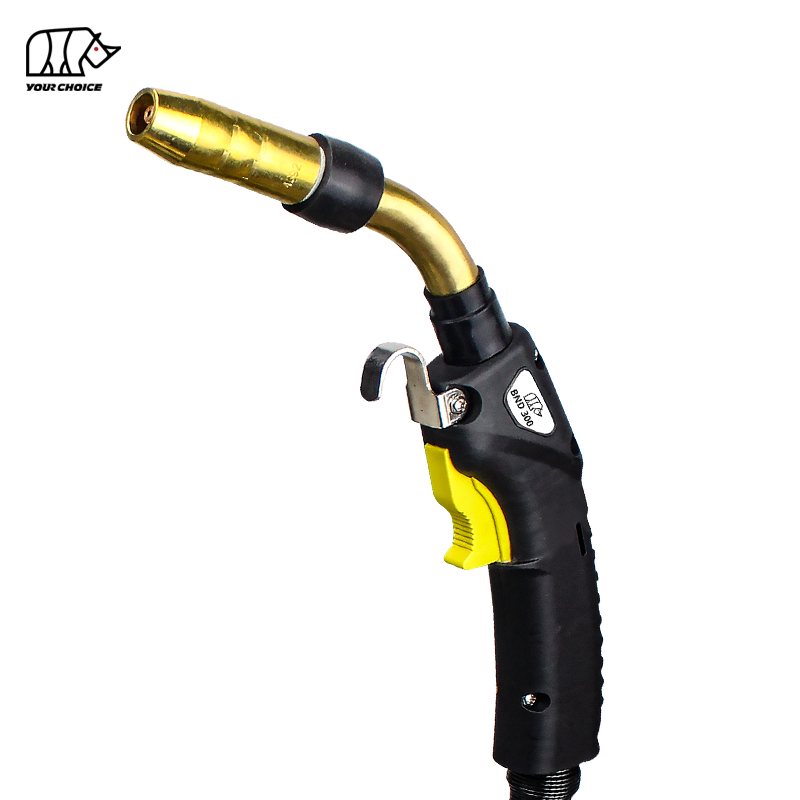
BND300 MIG Welding Torch Specifications at a Glance
| Specification | BND300 |
| Model | BND300 |
| Product type | MIG/MAG Welding Torch / Gun |
| Configuration | Bernard Style |
| Cooling | Air Cooled |
| Rated current | Up to 300A |
| Duty cycle | 60% |
| Wire diameter | 0.6–1.6 mm |
| Cable length | 3.6 m / 4.6 m |
| Handle | Ergonomic curved handle |
| Neck | Forged brass neck |
| Cable | INWELT Performance Cable |
| Front-end components | Contact tip, nozzle, diffuser and related consumables |
| Application | MIG/MAG welding, fabrication and repair |
| OEM customization | Available upon project requirements |
What Is the BND300 MIG Welding Torch?
The BND300 MIG Welding Torch is a Bernard-style manual MIG/MAG welding gun engineered for applications where operators need a balance of current capacity, maneuverability, cable flexibility, and everyday durability. The torch uses air cooling rather than a separate water-cooling system, which keeps the welding setup relatively simple and mobile. INWELT specifies the BND300 for up to 300A operation with a 60% duty cycle and a wire diameter range of 0.6–1.6 mm.
The BND300 should be positioned as a professional 300A air-cooled MIG torch, rather than simply as a replacement welding gun. Its product architecture focuses on operator handling as well as electrical performance, combining a curved handle, flexible cable system, brass neck, and replaceable front-end consumables.
This positioning is consistent with the wider professional MIG-gun market. Current industrial MIG-gun documentation from Miller's Bernard product line also emphasizes air-cooled guns, operator comfort, weld access, productivity, durability, and multiple output classes rather than treating amperage as the only selection criterion.
Why Choose a 300A Air-Cooled MIG Welding Gun?
A 300A air-cooled MIG gun is a practical choice when the welding application requires more capacity than a light-duty torch but does not justify the additional equipment associated with water cooling. The BND300 uses an air-cooled construction, allowing operators to work without a dedicated torch-water circulation system.
For fabrication shops and maintenance teams, simplicity can be an important advantage. There are fewer external cooling components to install, transport, inspect, or maintain, while the torch remains relatively easy to move around large workpieces.
The correct torch, however, should always be selected according to actual welding current, duty cycle, shielding gas, wire diameter, welding machine compatibility, and operating conditions. The 300A specification should not be interpreted as unlimited continuous operation at 300A.
What Does the BND300 60% Duty Cycle Mean?
The BND300 is listed with a 60% duty cycle. In practical terms, duty cycle describes the proportion of a defined test period during which the welding equipment can operate at its rated conditions before cooling is required.
This is why the phrase “300A MIG torch” should always be accompanied by its duty-cycle specification. Comparing two MIG guns only by their maximum amperage can produce a misleading result if their duty cycles, shielding-gas conditions, or testing standards differ.
Which Welding Wire Sizes Does the BND300 Support?
The BND300 is specified for 0.6–1.6 mm welding wire. This gives the torch flexibility across different MIG/MAG welding setups, from smaller-diameter wire applications through larger wire sizes used for higher deposition rates.
The actual wire diameter should always be matched with the contact tip, liner, wire feeder, welding current, wire material, and welding parameters. A properly matched front-end system helps maintain stable wire feeding and reliable electrical contact.
| Wire Diameter | Typical Consideration |
| 0.6 mm | Smaller wire applications |
| 0.8 mm | Common general-purpose MIG welding |
| 1.0 mm | General fabrication and production |
| 1.2 mm | Higher-deposition welding applications |
| 1.6 mm | Larger-wire industrial applications |
How Does the BND300 Ergonomic Handle Improve Welding Control?
The BND300 uses a curved ergonomic handle designed to improve operator positioning and control during manual welding. The handle is one of the most important parts of a MIG gun because it determines how naturally the operator can position the torch, activate the trigger, and maintain a consistent travel angle.
During long welding sessions, the torch becomes an extension of the operator's hand. A poorly balanced or uncomfortable handle can make repetitive welding more tiring, particularly when working around corners, inside frames, or in awkward positions.
The BND300's ergonomic approach should therefore be positioned around handling, access, control, and operator comfort, rather than making unsupported claims about specific productivity percentages.
What Makes the BND300 Performance Cable Different?
The BND300 uses an INWELT Performance Cable system designed to provide flexibility together with resistance to heat and abrasion. The current product page specifically highlights cable flexibility, heat resistance, and abrasion resistance as characteristics of the cable system.
Cable flexibility matters because a MIG torch is constantly moved, bent, repositioned, and dragged during welding. A cable that resists kinking can make torch manipulation easier and can reduce unnecessary mechanical stress during normal use.
Why Does the BND300 Use a Forged Brass Neck?
The BND300 features a forged brass neck designed to provide electrical conductivity and flexible torch positioning. The current product page states that the neck can rotate 360 degrees, allowing the operator to adjust the torch position when accessing tight or awkward welding joints.
This feature creates a strong practical distinction between a basic MIG gun and a torch designed with operator positioning in mind.
A rotatable neck can be particularly useful when welding:
Corners and internal joints
Frames and structural assemblies
Automotive components
Machinery
Tubular structures
Restricted-access workpieces
Complex fabrication assemblies
What MIG Torch Consumables Does the BND300 Use?
MIG torch performance depends heavily on its front-end consumables. The contact tip, nozzle, diffuser, liner, and neck assembly work together to deliver welding wire, transfer electrical current, and provide shielding gas around the arc.
The current BND300 product page specifically highlights a brass contact tip and copper-coated nozzle as part of its front-end design.
| Component | Primary Function |
| Contact tip | Transfers welding current to the wire |
| Gas nozzle | Directs shielding gas toward the weld area |
| Diffuser | Helps distribute shielding gas |
| Liner | Guides welding wire through the cable |
| Neck | Provides torch positioning and electrical connection |
| Handle | Provides operator grip and trigger control |
Is the BND300 a Bernard-Style MIG Welding Torch?
BND300 is a Bernard-style 300A air-cooled MIG welding torch designed for professional fabrication, repair, and industrial MIG/MAG applications.
What Cable Lengths Are Available for the BND300?
Cable length should be selected according to the workpiece size, welding station layout, operator movement, and wire-feeding requirements.
| Cable Length | Recommended Use |
| 3.6 m | General fabrication and compact workstations |
| 4.6 m | Larger workpieces and increased working reach |
A longer cable can provide greater operator reach, while a shorter cable may be easier to manage in compact work areas. The ideal configuration depends on the welding environment rather than simply choosing the longest available cable.
What Welding Applications Is the BND300 Designed For?
The BND300 is suitable for MIG/MAG welding applications including metal fabrication, repair, manufacturing, workshop welding, equipment maintenance, and general industrial welding. The 300A air-cooled format places it in the professional manual MIG-gun category rather than the lightest-duty class.
Is the BND300 Suitable for Metal Fabrication?
Yes. The BND300 is well suited to general metal fabrication where a 300A-class air-cooled MIG gun is appropriate.
Fabrication work often involves repeated welding along frames, brackets, panels, machinery components, structural assemblies, and other metal parts. In these environments, torch maneuverability and cable flexibility can be just as important as nominal amperage.
The BND300 combines the 300A-class format with an ergonomic curved handle, flexible cable system, and adjustable brass neck, giving it a practical configuration for manual fabrication work.
Is the BND300 Suitable for Heavy Equipment Repair?
The BND300 can be considered for heavy-equipment repair when the required welding parameters fall within the torch's rated operating conditions.
Heavy equipment repair often requires operators to weld around large and irregular components. A flexible cable and adjustable neck can make torch positioning easier when access is limited.
Can the BND300 Be Used for Stainless Steel Welding?
The BND300 can be used in MIG/MAG welding systems for stainless steel when the correct stainless-steel wire, shielding gas, contact tip, liner, and welding parameters are used.
Can the BND300 Be Used for Aluminum Welding?
The BND300 can be used in an aluminum MIG welding setup when the complete wire-feeding system is correctly configured for aluminum wire.
Aluminum wire is softer than many steel welding wires, so wire-feeding configuration becomes particularly important. Depending on the application, the welding system may require an appropriate liner, contact tip, drive-roll configuration, and suitable torch setup.
How Should the BND300 MIG Torch Be Maintained?
Regular cleaning and inspection of the contact tip, gas nozzle, diffuser, liner, cable, neck, and connector can help maintain reliable MIG torch operation.
MIG torch maintenance is relatively simple, but small problems can quickly become welding problems. Excessive spatter around the nozzle can interfere with shielding-gas flow, while a worn contact tip can affect electrical contact and wire guidance.
Recommended maintenance includes:
Clean welding spatter from the nozzle regularly.
Inspect the contact tip for wear or excessive bore enlargement.
Check the liner when wire feeding becomes inconsistent.
Inspect the cable for cuts, abrasion, crushing, or excessive bending.
Check the neck and connections for damage or looseness.
Replace worn consumables with the correct specifications.
Keep the gas nozzle and diffuser unobstructed to maintain appropriate shielding-gas delivery.
How Do You Choose the Right BND300 Configuration?
Choose the BND300 configuration according to five primary factors: welding current, duty cycle, wire diameter, cable length, and welding-machine compatibility.
| Selection Factor | BND300 Consideration |
| Welding current | Up to 300A according to product specification |
| Duty cycle | 60% |
| Wire diameter | 0.6–1.6 mm |
| Cable length | 3.6 m / 4.6 m |
| Cooling | Air cooled |
| Torch style | Bernard style |
| Application | MIG/MAG fabrication and repair |
| Consumables | Select according to wire and torch configuration |
Before ordering, buyers should confirm the welding machine interface, required cable length, wire diameter, front-end consumables, and operating current.
This is especially important for replacement-torch purchases. A visually similar MIG gun is not necessarily a direct replacement if the connector, liner, cable assembly, consumable system, or trigger configuration differs.
What Should Buyers Compare When Choosing a 300A MIG Gun?
A 300A MIG torch should not be selected on amperage alone. Buyers should compare the complete technical package.
| Comparison Factor | Why It Matters |
| Rated current | Determines the intended output class |
| Duty cycle | Indicates operating capability under specified conditions |
| Cooling method | Affects system complexity and thermal management |
| Wire range | Determines usable welding-wire sizes |
| Cable length | Determines operator reach |
| Handle design | Affects comfort and control |
| Neck design | Affects access to difficult joints |
| Cable flexibility | Affects maneuverability |
| Consumables | Determines maintenance requirements |
| Connector | Determines machine compatibility |
| Spare parts | Influences long-term operating cost |
| OEM capability | Important for distributors and private-label programs |
Why Is Cable Flexibility Important for a MIG Welding Torch?
Cable flexibility affects how easily an operator can position and move the MIG torch around the workpiece.
Manual MIG welding requires continuous torch movement. The operator may change direction, move around corners, reposition the gun, or reach across a large workpiece. A flexible cable can make these movements easier and reduce the tendency of the cable to resist the operator's motion.
How Does the BND300 Support Operator Comfort?
The BND300 combines several design elements around manual welding ergonomics, including a curved handle, flexible cable, and rotatable brass neck. Together, these features are intended to make torch positioning and handling more practical during welding.
What Safety and Fume-Control Considerations Apply When Using the BND300?
A MIG welding torch should always be used as part of a properly controlled welding environment with suitable ventilation, PPE, and work practices.
OSHA identifies welding fumes, ultraviolet radiation, burns, eye damage, electrical shock, cuts, and other hazards associated with welding operations.
For general welding operations, OSHA's requirements address ventilation and local exhaust systems, including positioning movable exhaust hoods as close as practicable to the welding area.
OSHA also notes that the composition and quantity of welding fumes depend on factors such as the metal being heated, welding process, coatings, filler material, number of welders, workspace air volume, and exhaust ventilation.
Can the BND300 Be Customized for OEM Projects?
The BND300 can be discussed as an OEM/private-label MIG torch for distributors and welding-equipment manufacturers, with project-specific requirements confirmed directly with INWELT.
For B2B buyers, OEM requirements may include:
| OEM Requirement | Possible Project Discussion |
| Branding | Logo and product identification |
| Color | Customized product appearance |
| Cable length | Standard or project-specific length |
| Connector | Required welding-machine interface |
| Consumables | Required front-end configuration |
| Packaging | Distributor/private-label packaging |
| Spare parts | Customized consumable packages |
| Samples | Pre-production approval |
| Volume | Wholesale production requirements |
What Are the Main Advantages of the BND300 MIG Welding Torch?
The BND300's main product advantages can be summarized as 300A-class capacity, air cooling, ergonomic handling, flexible cable construction, adjustable neck positioning, and a 0.6–1.6 mm wire range.
| BND300 Advantage | Buyer Benefit |
| 300A-class MIG torch | Suitable for higher-output manual MIG applications |
| Air cooled | Simple, mobile torch configuration |
| 60% duty cycle | Clearly defined operating rating |
| 0.6–1.6 mm wire range | Broad wire-size coverage |
| Curved ergonomic handle | Improved handling and positioning |
| Flexible performance cable | Easier torch movement |
| Forged brass neck | Electrical conductivity and positioning flexibility |
| 360° neck rotation | Better access to awkward joints |
| 3.6 m / 4.6 m options | Different working-radius requirements |
| Replaceable front-end components | Easier maintenance |
| Bernard-style configuration | Useful for replacement and distributor applications |
Frequently Asked Questions About the BND300 MIG Welding Torch
What is the BND300 MIG welding torch?
The BND300 is a 300A Bernard-style air-cooled MIG welding torch with a 60% duty cycle, 0.6–1.6 mm wire range, ergonomic curved handle, flexible performance cable, and 3.6 m or 4.6 m cable options.
How many amps is the BND300 MIG torch?
The BND300 is specified as a 300A MIG welding torch with a 60% duty cycle. Operating conditions should always remain within the manufacturer's stated rating and the requirements of the complete welding system.
Is the BND300 air cooled?
Yes. The BND300 is an air-cooled MIG welding torch. It does not use a dedicated water-cooling circuit as part of its stated cooling configuration.
What wire size does the BND300 support?
The current INWELT product specification lists a 0.6–1.6 mm wire diameter range. The contact tip and liner should be matched to the actual welding wire.
What cable lengths are available for the BND300?
The current product specification lists 3.6 m and 4.6 m cable lengths.
Is the BND300 a Bernard-style MIG gun?
Yes. INWELT identifies the BND300 as a Bernard-style MIG torch. Buyers should confirm the exact connector and consumable configuration when purchasing a replacement torch.
Can the BND300 be used for stainless steel?
Yes, the BND300 can be part of a stainless-steel MIG/MAG welding setup when the appropriate stainless wire, shielding gas, contact tip, liner, and welding parameters are used.
Can the BND300 be used for aluminum?
The BND300 can be used in an appropriately configured aluminum MIG welding system. Because aluminum wire is relatively soft, the liner, contact tip, drive rolls, wire-feeding system, and torch configuration should be selected specifically for aluminum welding.
How do I maintain a BND300 MIG torch?
Regularly inspect and clean the gas nozzle, contact tip, diffuser, liner, cable, and neck assembly. Replace worn or damaged consumables and make sure the liner and contact tip match the welding-wire diameter.
Is the BND300 suitable for industrial welding?
Yes, the BND300 is positioned as a professional 300A air-cooled MIG welding torch for fabrication, repair, manufacturing, and other industrial welding applications, provided the actual welding parameters remain within its rated conditions.
How do I choose between the 3.6 m and 4.6 m BND300?
Choose 3.6 m for more compact workstations and 4.6 m when additional operator reach is required. The best length depends on workpiece size, welding-machine location, and cable-management requirements.
 English
 简体中文
简体中文 العربية
 Français
 Русский
 Español
 Português
 Deutsch
 italiano
 日本語
日本語 한국어
한국어 Nederlands
 Tiếng Việt
 ไทย
ไทย Polski
 Türkçe
 ភាសាខ្មែរ
 Bahasa Melayu
 Filipino
 Bahasa Indonesia
 magyar
 Română
 Čeština
 Монгол
 қазақ
қазақ Српски
 हिन्दी
 فارسی
فارسی Slovenčina
 Slovenščina
 Norsk
Norsk Svenska
 українська
 Ελληνικά
 Suomi
Suomi Latine
 Dansk
Dansk বাংলা
বাংলা Hrvatski
 Afrikaans
 Gaeilge
 Eesti keel
 नेपाली
 Oʻzbekcha
 latviešu
 Azərbaycan dili
 Беларуская мова
 Bosanski
 Български
 ქართული
 Lietuvių