INWELT MIG Welding Ceramic Gas Diffuser — Premium Torch Consumables for 24KD, 36KD, and 501D
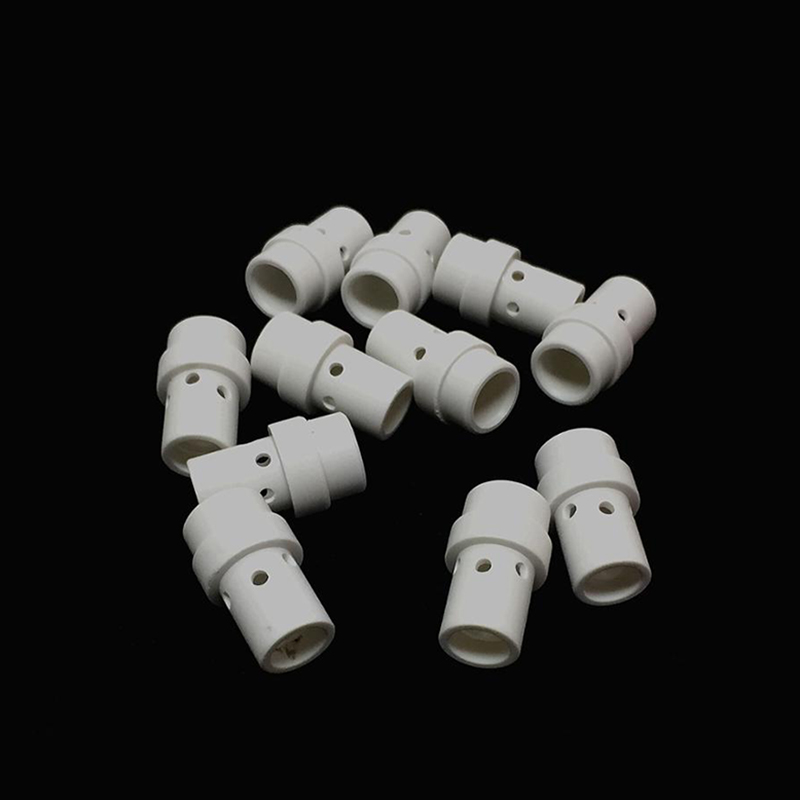
The MIG gas diffuser is a small but critical component that sits between the torch neck and the contact tip. Despite its modest size, the gas diffuser plays an outsized role in determining weld quality. As the last stop for shielding gas before it exits the nozzle and envelops the weld pool, the diffuser must transform turbulent, fast-moving gas into a smooth, laminar flow that evenly blankets the arc zone. INWELT manufactures precision ceramic gas diffusers engineered to deliver stable gas distribution, long service life, and reliable spatter resistance across the most widely used Binzel-type MIG torch platforms: the 24KD, 36KD, and 501D series.
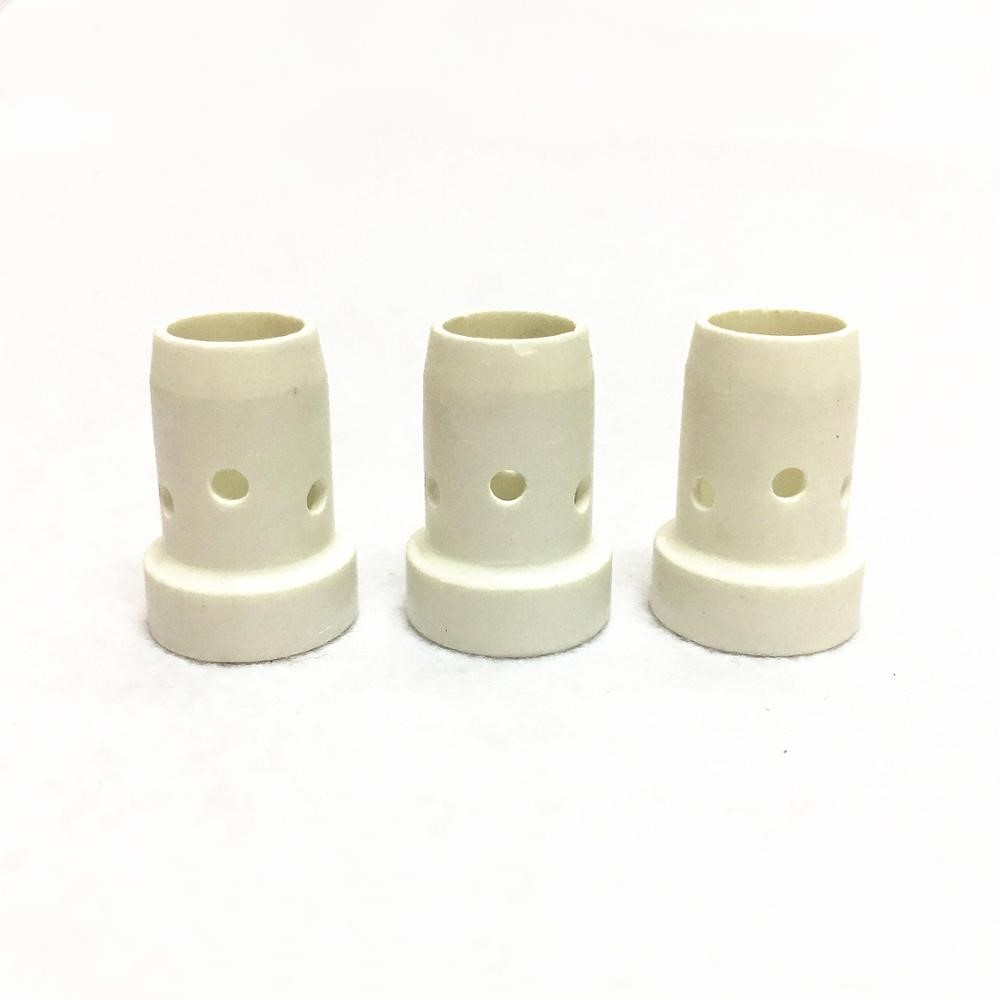
The Function and Importance of a MIG Gas Diffuser
Understanding how the gas diffuser works inside the torch assembly is the first step toward recognizing when it needs cleaning or replacement.
Laminar Gas Flow Distribution
The primary function of the gas diffuser is also reflected in its name: it diffuses, or spreads out, the shielding gas as it travels from the torch cable toward the nozzle. Raw shielding gas enters the diffuser through a single central passage and exits through multiple evenly spaced radial ports. This port layout breaks up turbulent flow and recirculation zones, creating a uniform, laminar stream of shielding gas around the contact tip and weld wire. When the gas exits the nozzle in a smooth, even column, it provides consistent atmospheric protection across the entire weld pool — the foundation of a porosity-free MIG weld.
Contact Tip Positioning and Alignment
In addition to managing gas flow, the gas diffuser serves as the mounting base for the contact tip. The diffuser positions the contact tip precisely along the center axis of the torch, ensuring the weld wire feeds straight through the nozzle bore. Any deviation caused by a worn or misaligned diffuser changes contact-tip-to-work distance and can produce arc instability. The diffuser threads directly into the torch neck on one end, and the contact tip threads into the diffuser on the other, making this component the critical structural link between the torch body and the electrical contact point.
Spatter Protection for Internal Torch Components
The diffuser also acts as a physical barrier that shields upstream torch components from welding spatter. Hot spatter droplets that would otherwise travel up into the torch neck and damage internal gas passages are blocked by the diffuser body. This protective function extends the service life of more expensive torch components, making the gas diffuser a cost-effective sacrificial wear part.
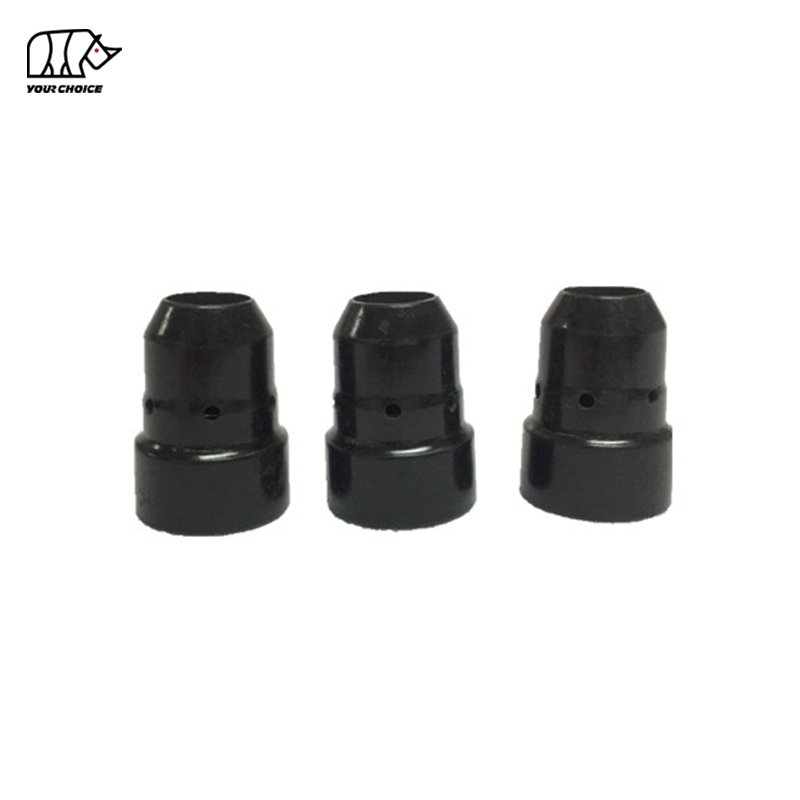
Why Ceramic — Material Advantages of INWELT Gas Diffusers
MIG gas diffusers are commonly manufactured from brass or ceramic. Each material has its place, but for high-amperage, high-duty-cycle applications, ceramic offers distinct and measurable advantages.
Superior High-Temperature Resistance
Ceramic gas diffusers withstand significantly higher operating temperatures than their brass counterparts. In heavy fabrication, automated welding cells, and high-amperage spray transfer applications, the radiant heat from the arc and the resistance heating of the contact tip can raise the diffuser temperature far beyond what brass can endure without softening or deforming. Ceramic diffusers maintain their structural integrity and dimensional stability at these elevated temperatures, ensuring consistent gas port geometry and contact tip alignment throughout the welding cycle.
Electrical Insulation Properties
Unlike brass, ceramic is an electrical insulator. This property eliminates the risk of secondary arcing between the diffuser body and the inside of the gas nozzle — a problem that can occur with brass diffusers in confined-nozzle applications. By preventing unintended current paths, ceramic diffusers contribute to more stable arc characteristics and reduce the incidence of nozzle damage caused by internal arcing.
Spatter Adhesion Resistance
One of the most persistent maintenance headaches in MIG welding is spatter accumulation inside the gas nozzle. Molten spatter droplets readily adhere to metal surfaces, progressively clogging gas ports on brass diffusers and disrupting shielding gas flow. Ceramic surfaces resist spatter adhesion naturally — spatter that contacts the ceramic diffuser body tends to flake off or can be removed far more easily during routine cleaning. This property keeps gas ports clear for longer, maintaining consistent shielding gas coverage between maintenance intervals.
Corrosion and Chemical Resistance
The interior of a MIG torch is exposed to heat, shielding gas mixtures, and atmospheric moisture. Brass diffusers can develop surface oxidation and corrosion over time, particularly in humid workshop environments or when aggressive shielding gas blends are used. Ceramic is chemically inert and unaffected by these conditions, retaining its surface finish and gas port dimensions for the full service life of the component.
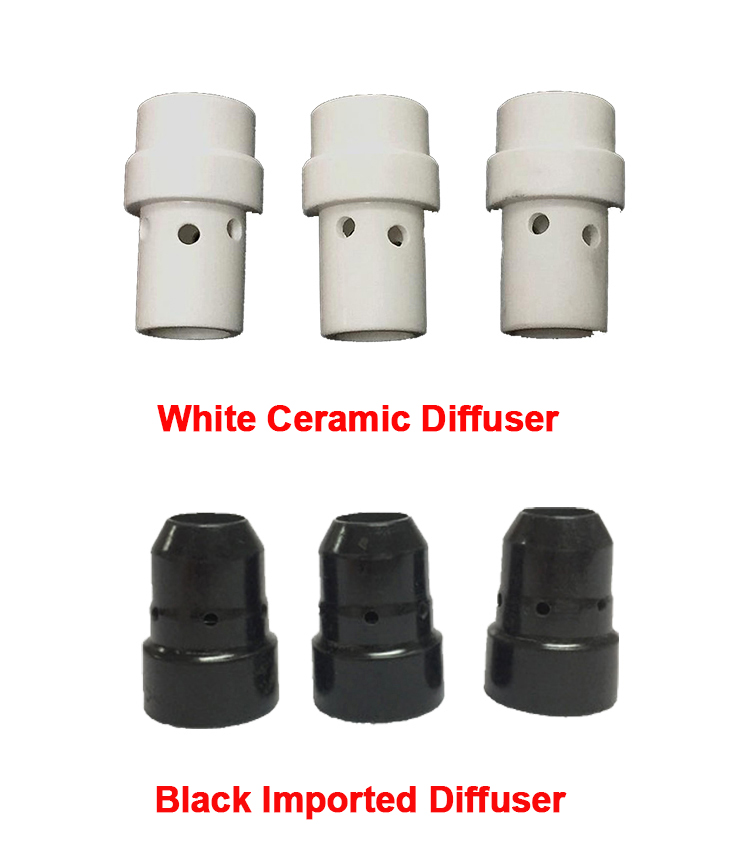
Model Compatibility — 24KD, 36KD, and 501D Torch Platforms
INWELT ceramic gas diffusers are manufactured for the three most widely deployed Binzel-type MIG torch platforms. Selecting the correct diffuser for your torch is essential — the physical dimensions, thread specifications, and gas port configurations differ between models.
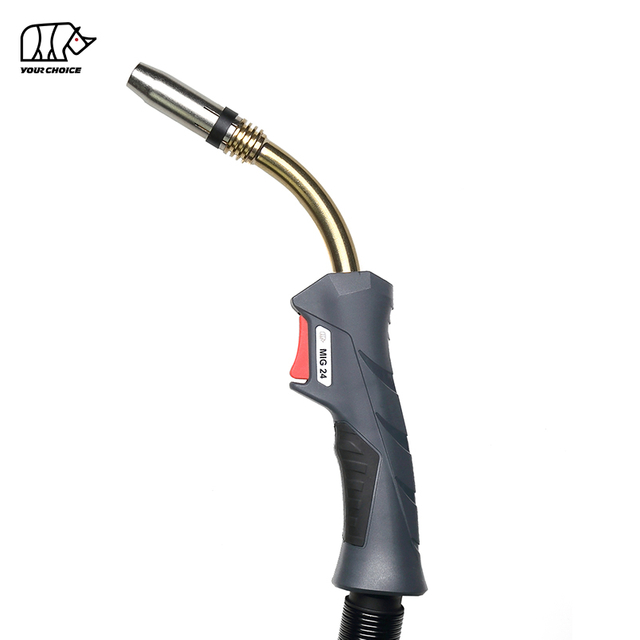
24KD Gas Diffuser — Light to Medium-Duty Applications
The 24KD torch platform is widely used in light to medium fabrication, automotive repair, and general MIG welding up to approximately 250 amps. It is an air-cooled torch design suited to workshops and field service applications where portability and ease of handling are priorities.
| Specification | Detail |
| Compatible Torch Model | Binzel MB 24KD (air-cooled) |
| Typical Amperage Range | Up to 250A |
| Material | High-grade ceramic |
| Key Applications | Light fabrication, automotive, general workshop |
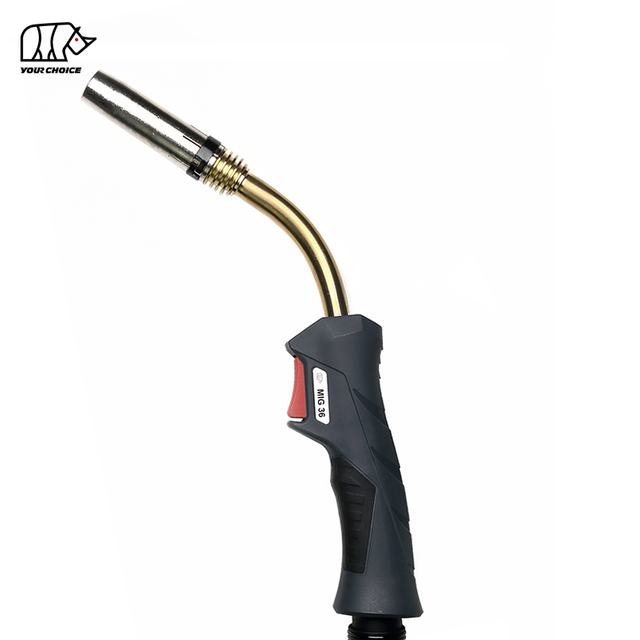
36KD Gas Diffuser — Medium to Heavy-Duty Applications
The 36KD platform steps up in capacity to handle medium and heavy fabrication work at currents approaching 350 amps. Air-cooled and robust, the 36KD torch is a standard workhorse in structural steel shops, shipbuilding, and industrial manufacturing environments.
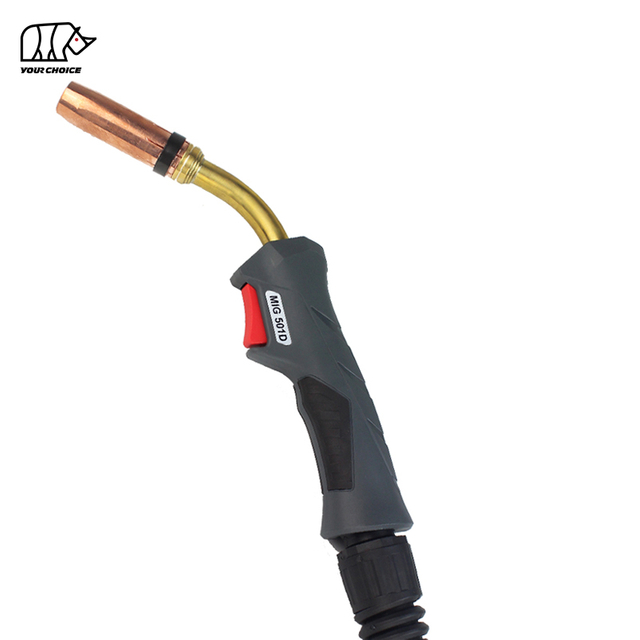
501D Gas Diffuser — Heavy-Duty and Water-Cooled Applications
The 501D is a water-cooled torch platform designed for sustained high-amperage welding at 400 to 500 amps. Water cooling allows the torch to handle continuous duty cycles that would overheat an air-cooled torch in minutes. The ceramic gas diffuser for 501D platforms must withstand extreme thermal cycling while maintaining precise gas distribution — exactly the conditions where ceramic outperforms brass.
| Specification | Detail |
| Compatible Torch Model | Binzel MB 501D (water-cooled) |
| Typical Amperage Range | Up to 500A |
| Material | High-grade ceramic |
| Key Applications | Heavy fab, automated welding, high-deposition |
Gas Diffuser Maintenance — Cleaning, Inspection, and Replacement
A properly maintained gas diffuser ensures consistent shielding gas coverage, stable arc performance, and predictable contact tip life. Neglecting diffuser maintenance is one of the most common avoidable causes of MIG weld defects.
Routine Cleaning Procedure
During daily torch maintenance, remove the gas nozzle and contact tip to access the diffuser. Use a pair of MIG welding pliers or a dedicated nozzle reamer to carefully remove any spatter accumulation from the diffuser body and gas ports. Avoid using hardened steel tools that can scratch the ceramic surface or chip the gas port edges. A soft brass brush or dedicated anti-spatter spray applied sparingly to the diffuser face helps prevent spatter buildup between cleaning cycles.
Warning Signs That Replacement Is Needed
The diffuser should be replaced when any of the following conditions are observed: gas ports are visibly clogged and cannot be fully cleared by routine cleaning; the ceramic body shows cracks, chips, or structural damage; the contact tip threads feel loose or stripped, preventing secure contact tip installation; or the diffuser threads that engage the torch neck are worn, cross-threaded, or no longer tighten securely. A damaged or clogged diffuser will produce turbulent or uneven shielding gas flow, leading directly to weld porosity, excessive spatter, and arc instability.
Preventive Replacement Intervals
For production welding environments with high duty cycles, gas diffusers should be inspected at every wire change or nozzle cleaning and replaced at the first sign of gas port degradation. For critical code-quality work where weld integrity directly impacts safety, scheduled preventive replacement at regular intervals is a low-cost measure that eliminates gas coverage variability as a potential defect source. Experienced welding supervisors keep spare diffusers for every torch model in the shop — replacement takes less than 60 seconds and costs far less than the labor required to grind out and re-weld a failed joint.
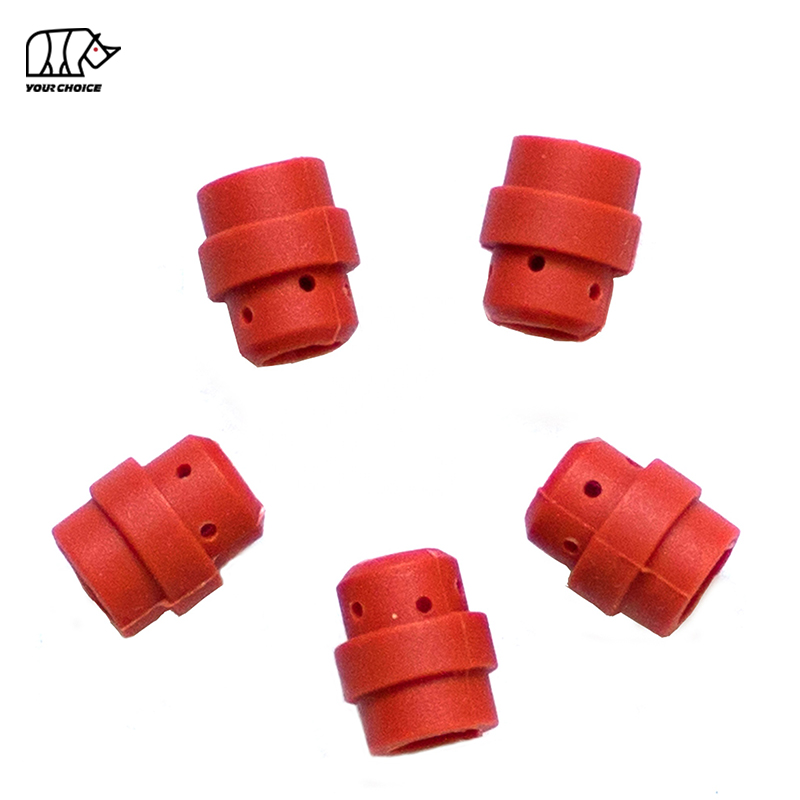
Real-World Applications
INWELT ceramic gas diffusers are deployed daily in demanding industrial environments where weld quality and torch reliability directly impact productivity.
Heavy Equipment and Structural Fabrication: 36KD and 501D torch platforms fitted with ceramic diffusers support high-deposition MIG welding of excavator booms, crane structures, bridge components, and heavy machinery frames where arc-on time is measured in hours per shift.
Shipbuilding and Marine Repair: The water-cooled 501D platform with ceramic gas diffuser handles continuous welding of hull plates, stiffeners, and marine structural components in shipyard environments where duty cycles are extreme.
Automotive and Light Fabrication: 24KD torches with ceramic diffusers provide consistent gas coverage for sheet metal welding, exhaust system fabrication, and repair work where weld appearance and minimal post-weld cleanup are priorities.
Automated and Robotic Welding Cells: Ceramic gas diffusers are preferred in robotic MIG applications because their spatter resistance extends the interval between automated torch cleaning cycles, improving cell uptime and reducing maintenance intervention.
Pipeline and Process Piping Fabrication: Consistent laminar gas flow from ceramic diffusers supports the radiographic-quality weld standards required in process piping, pressure vessel, and pipeline construction.
Why Source MIG Gas Diffusers from INWELT Welding Technology Co., Ltd.
When selecting welding consumables for production environments, the distinction between a dedicated manufacturer and a general trading intermediary has direct consequences for product consistency, material quality, and long-term supply reliability.
ISO 9001 Certified Manufacturing: Every production batch of INWELT gas diffusers is manufactured under a documented quality management system with traceable ceramic material sourcing, in-process dimensional verification, and final visual inspection.
CE and RoHS Compliance: All materials meet international safety and environmental standards, confirming fitness for professional and industrial use in regulated markets worldwide.
Direct-from-Factory Supply: As the original manufacturer, INWELT provides competitive factory-direct pricing on both sample and volume orders. OEM and ODM customization options are available, including custom packaging, private-label branding, and non-standard thread specifications for specialized torch platforms.
Free Sample Evaluation: Product samples are available for hands-on evaluation of fit, thread engagement, gas port geometry, and material quality before committing to volume orders. This ensures the diffusers integrate seamlessly with your existing torch inventory.
15+ Years of Industry Experience: Since 2006, INWELT has supplied welding consumables to professionals in over 30 countries. The company has built a reputation for batch-to-batch consistency, responsive technical support, and reliable delivery timelines that production environments depend on.
Complete MIG Torch Consumable Range: INWELT manufactures the full range of matching front-end consumables for 24KD, 36KD, and 501D torch platforms — contact tips, gas nozzles, tip holders, liners, and neck adapters — ensuring uniform quality and guaranteed part-to-part compatibility.
Frequently Asked Questions
Q: What is the function of a MIG welding gas diffuser?
A: The gas diffuser is a component installed between the MIG torch neck and the contact tip. It performs three key functions: it distributes incoming shielding gas through multiple radial ports to create a smooth, laminar flow pattern around the contact tip and weld wire; it serves as the mounting base that positions and secures the contact tip in correct axial alignment with the torch centerline; and it acts as a physical spatter barrier protecting upstream torch components from damage.
Q: Why choose a ceramic gas diffuser instead of brass?
A: Ceramic gas diffusers offer several distinct advantages over brass in medium to heavy-duty MIG welding applications. Ceramic withstands higher operating temperatures without softening or deforming, making it the preferred choice for high-amperage and high-duty-cycle work. Its electrical insulation properties eliminate the risk of secondary arcing between the diffuser and gas nozzle. Ceramic surfaces naturally resist spatter adhesion, keeping gas ports clear for longer and reducing maintenance frequency. Ceramic is also chemically inert and does not corrode in humid environments or when exposed to mixed shielding gases.
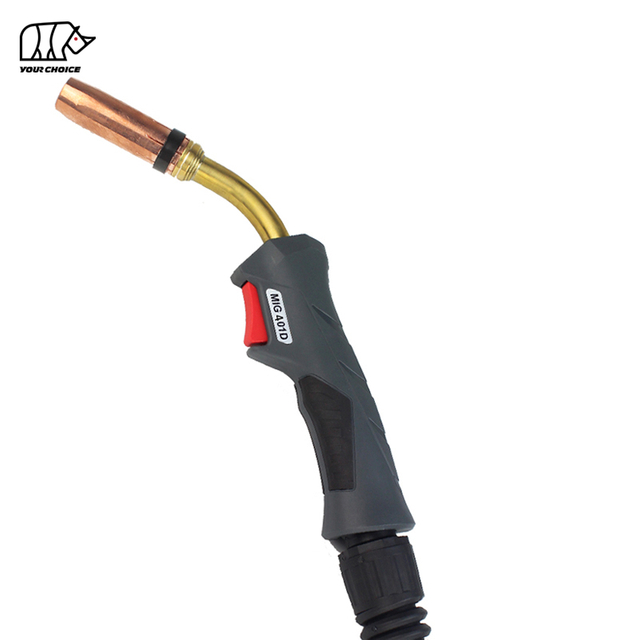
Q: How do I know which model fits my MIG torch — 24KD, 36KD, or 501D?
A: The torch model designation is typically marked on the torch handle or neck. 24KD is an air-cooled torch for light to medium fabrication up to approximately 250 amps. 36KD is an air-cooled torch for medium to heavy fabrication up to approximately 350 amps. 501D is a water-cooled torch for heavy fabrication and automated welding up to approximately 500 amps. If the torch model is not legible on the equipment, the physical dimensions and thread specifications can be provided to verify the correct diffuser fitment.
Q: How often should a ceramic gas diffuser be replaced?
A: Diffusers should be inspected during every nozzle and contact tip change. Replace the diffuser immediately if gas ports are clogged and cannot be fully cleared, the ceramic body is cracked or chipped, the contact tip threads are stripped, or the torch neck threads are worn and no longer tighten securely. For production environments with high duty cycles, preventive replacement based on arc hours rather than waiting for visible failure helps maintain consistent weld quality and avoids unscheduled downtime.
Q: Can a clogged or damaged gas diffuser cause weld porosity?
A: Yes. A partially or fully clogged diffuser disrupts shielding gas flow, creating turbulence and uneven gas coverage around the weld pool. This allows atmospheric contamination — oxygen, nitrogen, and moisture — to reach the molten weld metal, producing porosity, surface pitting, and oxidation. When troubleshooting intermittent or sudden-onset porosity in MIG welding, inspecting the gas diffuser for blockage or damage should be one of the first diagnostic steps after confirming adequate gas supply at the flowmeter.
Q: Are INWELT ceramic gas diffusers compatible with original Binzel torches and aftermarket equivalents?
A: Yes. INWELT gas diffusers are manufactured to standard industry dimensions and are fully compatible with original Binzel MB 24KD, MB 36KD, and MB 501D torches, as well as aftermarket torch equivalents from major manufacturers that follow the same dimensional standard. The ceramic diffusers feature the same thread specifications, gas port layout, and contact tip interface geometry as the OEM components.
Q: Can ceramic gas diffusers be used in automated and robotic welding cells?
A: Yes. In fact, ceramic gas diffusers are often preferred over brass in automated and robotic MIG welding applications. Their superior spatter resistance extends the interval between automated torch cleaning station cycles, improving overall cell uptime. Their dimensional stability at sustained high temperatures also ensures consistent gas coverage and contact tip positioning during extended production runs where the torch may be in continuous operation for hours.
Product Specifications at a Glance
 English
 简体中文
简体中文 العربية
 Français
 Русский
 Español
 Português
 Deutsch
 italiano
 日本語
日本語 한국어
한국어 Nederlands
 Tiếng Việt
 ไทย
ไทย Polski
 Türkçe
 ភាសាខ្មែរ
 Bahasa Melayu
 Filipino
 Bahasa Indonesia
 magyar
 Română
 Čeština
 Монгол
 қазақ
қазақ Српски
 हिन्दी
 فارسی
فارسی Slovenčina
 Slovenščina
 Norsk
Norsk Svenska
 українська
 Ελληνικά
 Suomi
Suomi Latine
 Dansk
Dansk বাংলা
বাংলা Hrvatski
 Afrikaans
 Gaeilge
 Eesti keel
 नेपाली
 Oʻzbekcha
 latviešu
 Azərbaycan dili
 Беларуская мова
 Bosanski
 Български
 ქართული
 Lietuvių