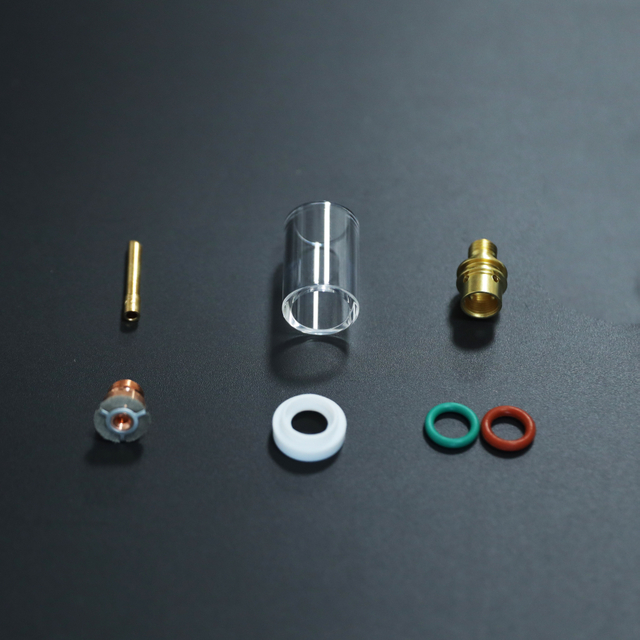
When you push abrasive, high-temperature filaments through your 3D printer nozzle day after day, standard brass simply will not hold up. Ceramic nozzles have emerged as the go-to upgrade for makers printing carbon-fiber-filled nylons, glow-in-the-dark PLAs, and engineering-grade materials that chew through softer metals in a matter of hours. But not all ceramics are created equal. Three materials dominate the conversation—alumina (aluminum oxide), lava (alumina silicate), and silicon nitride—each with fundamentally different properties that directly affect print quality, nozzle longevity, and your overall printing experience.
Below, we break down what each material is, how it performs, what it costs, and which one belongs in your hot end based on what you actually print.
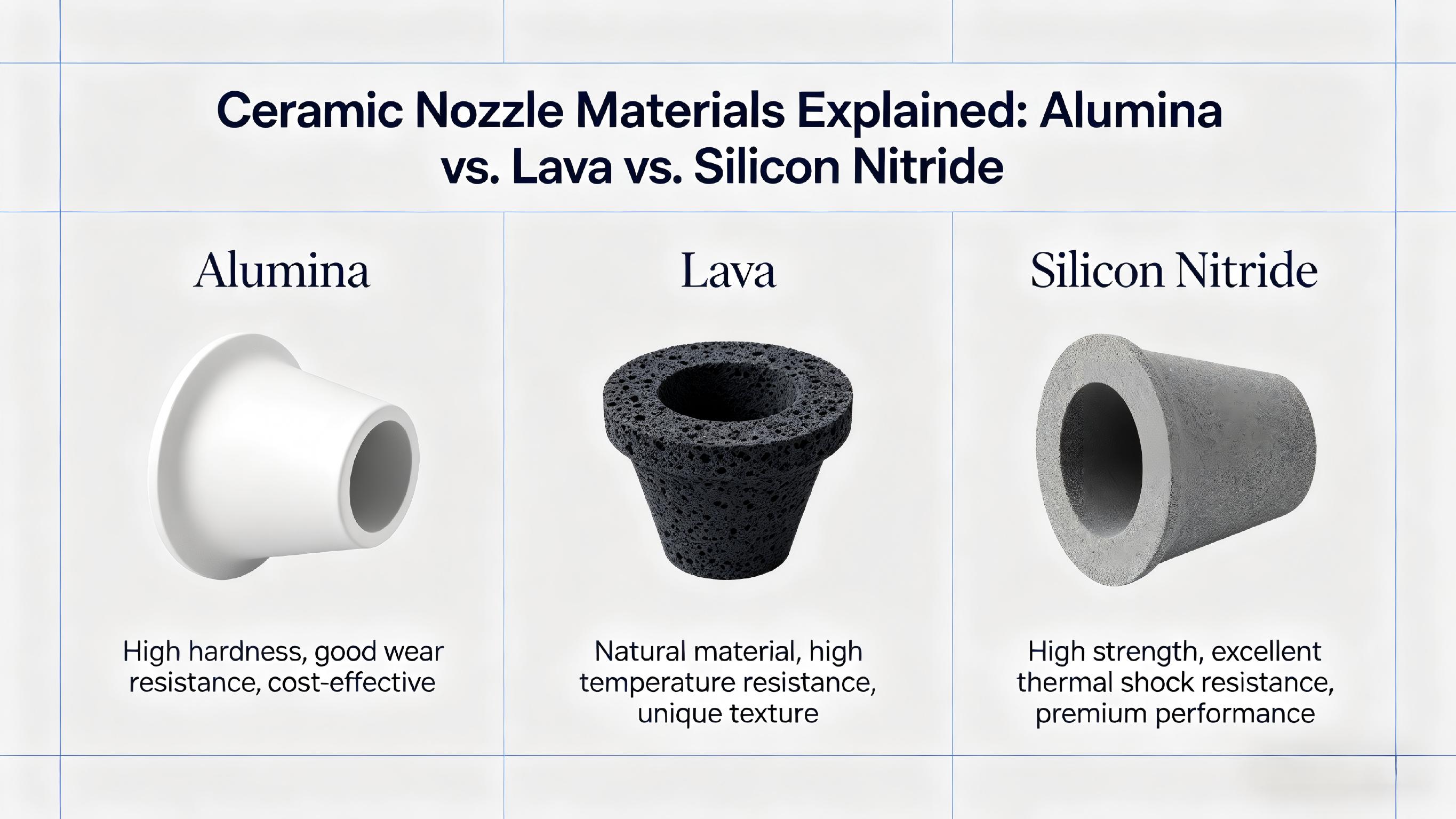
Understanding Ceramic Nozzle Materials
Ceramics occupy a unique position in the nozzle material landscape. Unlike metals—which deform, erode, and oxidize under aggressive conditions—technical ceramics offer exceptional hardness, chemical inertness, and thermal stability. Alumina, for example, typically measures around 1600 HV on the Vickers hardness scale, placing it among the hardest readily available nozzle materials. This hardness translates directly into wear resistance when printing abrasive filaments.
However, hardness alone does not tell the full story. Each ceramic material brings a distinct combination of thermal conductivity, fracture toughness, and thermal shock resistance to the table. Thermal conductivity determines how efficiently heat transfers from the heater block to the molten filament—too low, and you will struggle to maintain consistent melt flow at higher speeds. Fracture toughness dictates how well the material resists crack propagation from sudden impacts or thermal stress. Thermal shock resistance determines whether your nozzle survives rapid temperature cycling from ambient to 250 °C and back without developing micro-cracks.
Understanding these trade-offs is essential because no single ceramic material is best for every application. A nozzle that excels with abrasive PLA may crack under the thermal cycling demands of high-temperature polycarbonate. A material that handles 300 °C with ease may prove too brittle for a printer that occasionally crashes its nozzle into the bed. The choice is fundamentally about matching material properties to your printing workflow.
Alumina Nozzles: The Industry Workhorse
Alumina (Al₂O₃), or aluminum oxide, is the most widely used industrial ceramic today and the entry point for most makers moving beyond brass nozzles. Derived from bauxite and refined to purity levels ranging from 96% to 99.8%, alumina nozzles strike a practical balance between performance and cost that has made them the default ceramic option for many 3D printing applications.
Material Composition and Key Properties
Alumina is an oxide ceramic formed by sintering aluminum oxide powder at temperatures approaching 1700 °C. The resulting material exhibits a combination of properties that directly benefits 3D printing. Its hardness registers around 9 on the Mohs scale and 1600–2000 HV on the Vickers scale, providing wear resistance dramatically superior to brass, stainless steel, and even many hardened tool steels. Dense alumina delivers flexural strength in the range of 260 to 430 MPa, giving it sufficient mechanical integrity to withstand the compressive forces inside a hot end.
Thermal conductivity for alumina falls between 25 and 35 W/(m·K) at room temperature, which is notably higher than many users expect from a ceramic material. This level of conductivity supports reliable heat transfer for printing standard materials like PLA, ABS, and PETG at typical speeds, though it is lower than brass (approximately 120 W/(m·K)). The maximum service temperature reaches approximately 1700 °C in air, far exceeding what any consumer or industrial FDM hot end requires.
Where alumina shows its limitations is in fracture toughness. With values typically ranging from 2.7 to 4.0 MPa·m⊃1;/⊃2;, alumina is relatively brittle. Thermal shock resistance is a known weakness: alumina can withstand temperature changes of approximately 250 °C before risking crack initiation. This means that while alumina handles standard printing temperatures without issue, rapid thermal cycling at the upper end of its practical range can introduce micro-cracks over time, eventually leading to catastrophic failure. Sudden impacts—such as a nozzle crash into the print bed—can also cause chipping or fracture.
Typical Applications in FDM Printing
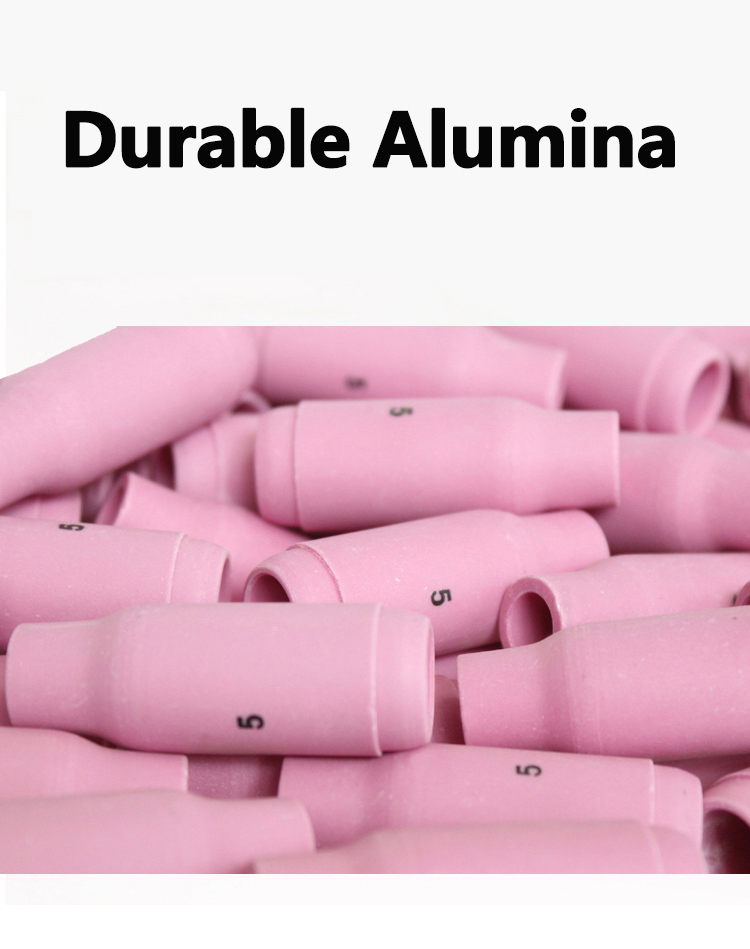
Alumina nozzles are an excellent entry point for makers transitioning from brass to abrasive-resistant printing. They handle carbon-fiber-filled PLA, PETG, and nylon with ease, maintaining orifice geometry far longer than unhardened metal alternatives. For general-purpose printing with occasional abrasive filaments, an alumina nozzle provides a meaningful upgrade in longevity without the cost premium of more exotic ceramics.
Printing environments involving rapid temperature swings between ambient and very high temperatures, however, push against alumina's thermal shock limitations. Users who routinely print engineering filaments at 280 °C and above while allowing the nozzle to cool completely between prints should monitor for signs of micro-cracking at the orifice.
Advantages and Limitations
On the plus side, alumina nozzles offer very high hardness and wear resistance, good thermal conductivity for consistent melt flow at moderate speeds, excellent chemical inertness across a wide range of filament chemistries, stable performance at temperatures well beyond FDM requirements, and a cost-effective price point relative to other ceramics.
The trade-offs are real: lower fracture toughness translates into brittleness and vulnerability to impact damage, thermal shock resistance is noticeably limited compared to tougher ceramics, and any surface defects or machining marks introduced during manufacturing can serve as crack initiation sites under stress. Alumina is a wear-resistant workhorse, but not an indestructible one.
Lava Nozzles: The Machinable Natural Ceramic
Among ceramic nozzle materials, lava occupies a unique position. Also known as alumina silicate or by its trade designation Grade A Lava, this naturally occurring ceramic offers properties distinctly different from its engineered counterparts. Originally used extensively in gas welding nozzles, lava has found a niche in certain 3D printing applications where its specific characteristics align with user needs.
What Lava Actually Is—Composition and Origin
Lava is a naturally occurring hydrated alumina silicate, a material mined and processed rather than synthesized from purified powders. In chemical terms, it is a hydrous alumina silicate, meaning it contains both aluminum oxide and silicon dioxide in its structure along with chemically bound water. This natural origin gives lava properties that differ fundamentally from sintered technical ceramics like alumina or silicon nitride.
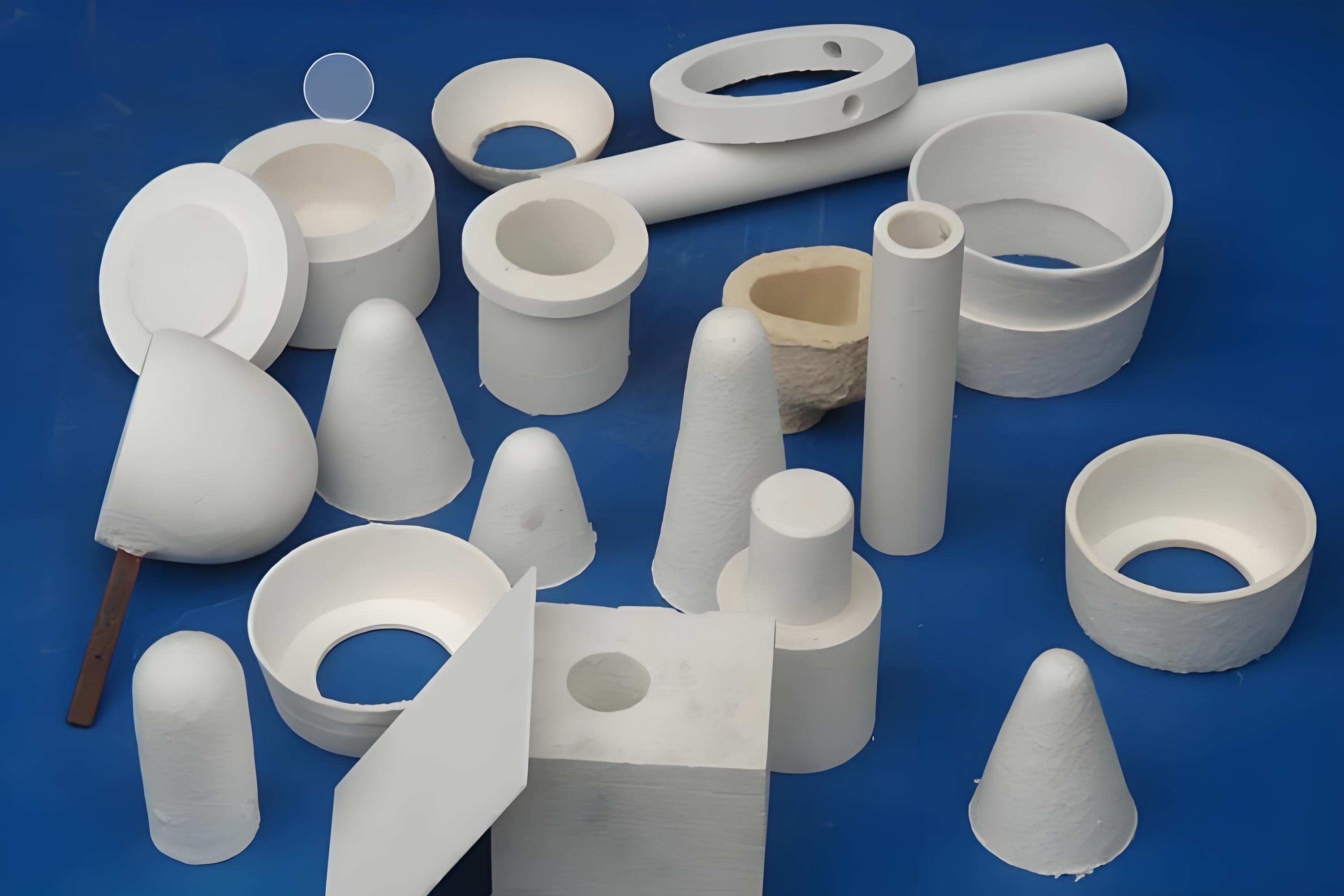
One distinctive characteristic is machinability in the unfired state. Unlike alumina or silicon nitride, which require diamond tooling and grinding, lava can be machined using conventional cutting tools before firing. After machining, lava parts undergo a heat treatment process at temperatures between 1010 °C and 1093 °C—approximately 1850 °F to 2000 °F—to mature the ceramic and develop its final properties. This machinability makes lava attractive for prototyping and small-batch production of custom nozzle geometries.
Key Properties Relevant to 3D Printing
Lava's properties set it apart from the other ceramics in this comparison. Its thermal conductivity measures approximately 2.0 W/(m·K), roughly an order of magnitude lower than alumina. This low conductivity makes lava an effective thermal insulator, a property valued in welding applications but one that can complicate efforts to maintain consistent melt temperatures in FDM printing. Maximum continuous use temperature is around 1150 °C (2100 °F) after firing. Lava also exhibits good thermal shock properties and can withstand long-term thermal cycling better than some technical ceramics.
Mechanically, lava is softer than alumina and silicon nitride. In the unfired state, it is described as fairly soft with low mechanical properties; after firing, it gains strength but remains less hard than the engineered ceramics. Compressive strength for fired lava is approximately 40,000 psi (roughly 276 MPa), with tensile strength around 2,500 psi (approximately 17 MPa).
Where Lava Nozzles Excel—and Where They Fall Short
Lava's low thermal conductivity can be either a feature or a limitation depending on the application. In welding, where the nozzle must shield the weld area from reflected heat, insulating properties are advantageous. In FDM printing, however, low thermal conductivity can result in slower heat transfer from the heater block to the filament, potentially limiting maximum print speeds.
Lava nozzles are less shock- and heat-resistant than their alumina counterparts, a consideration for users pushing temperature limits. They are best suited for applications where electrical insulation, moderate thermal resistance, and ease of machining take priority over maximum hardness or wear resistance. In the 3D printing world, lava nozzles remain a specialist choice—useful when their specific insulating characteristics are needed, but generally not the optimal selection for high-speed or abrasive filament printing.
Silicon Nitride Nozzles: The Premium Performer
If alumina is the workhorse and lava the specialist, silicon nitride (Si₃N₄) is the thoroughbred. This non-oxide technical ceramic has gained significant attention in 3D printing circles for its exceptional combination of toughness, thermal shock resistance, and high-temperature performance. Originally developed for demanding applications like aerospace bearings and cutting tools, silicon nitride brings capabilities that directly address the weaknesses of alumina and other ceramics.
Material Science: Why Silicon Nitride Stands Apart
Silicon nitride is fundamentally different from oxide ceramics like alumina and lava. Its unique microstructure—elongated beta-silicon nitride grains interlocked within a glassy phase matrix—delivers a rare combination of high strength and high fracture toughness. Flexural strength for dense silicon nitride can reach 650 to 750 MPa and in some formulations exceeds 800 MPa, substantially higher than alumina's 260 to 430 MPa. Fracture toughness measures 6.0 to 8.0 MPa·m⊃1;/⊃2;—roughly double that of alumina—meaning cracks propagate far less readily under stress.
Hardness is equally impressive at 14 to 16 GPa (approximately 1500–1700 HV), placing silicon nitride among the hardest technical ceramics and on par with alumina in wear resistance. The density is low at approximately 3.2 g/cm³, making it lighter than most competing materials.
Perhaps the most distinguishing property for 3D printing is thermal shock resistance. Silicon nitride exhibits a coefficient of thermal expansion of 3 to 4 × 10⁻⁶/°C, roughly one-third that of alumina at 8 to 9 × 10⁻⁶/°C. Combined with thermal conductivity in the range of 15 to 25 W/(m·K), this low expansion allows silicon nitride to withstand rapid temperature swings—from 1000 °C to room temperature in testing—without cracking, a capability alumina cannot match. Thermal shock resistance is rated at 450 to 650 °C in standard tests, versus alumina's approximate 250 °C limit.
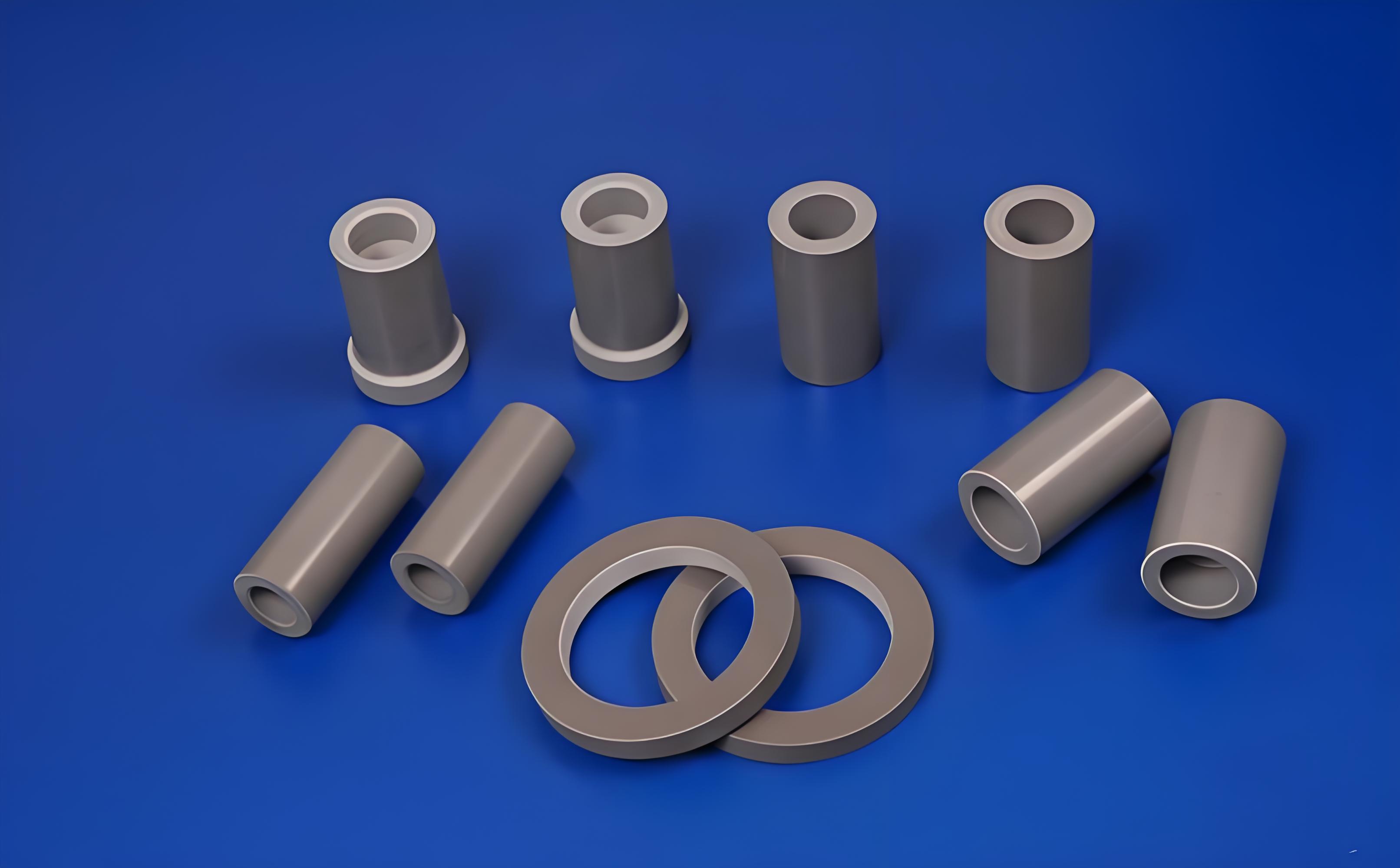
Industrial and 3D Printing Applications
Silicon nitride's property suite makes it particularly relevant for demanding FDM applications. The material can handle continuous use at 1400 °C with short-term capability up to 1600 °C, well beyond any current 3D printing requirement. The combination of high fracture toughness and thermal shock resistance means silicon nitride nozzles tolerate the thermal cycling inherent to FDM without developing the micro-cracks that eventually compromise alumina nozzles under similar conditions.
In the broader 3D printing market, silicon nitride is gaining traction in aerospace applications where reliability under extreme thermal and mechanical conditions is non-negotiable. For makers printing abrasive engineering filaments at high temperatures—PEEK, PEI (ULTEM), carbon-fiber-reinforced nylons—a silicon nitride nozzle offers near-permanent wear life combined with thermal resilience that survives years of hard use. The hardness and wear resistance are sufficient to maintain precise orifice geometry even under continuous abrasive filament flow.
Strengths and Weaknesses
Silicon nitride combines high flexural strength and fracture toughness with Vickers hardness comparable to alumina. Its exceptional thermal shock resistance far exceeds other ceramics, while low thermal expansion ensures dimensional stability during heating and cooling cycles. Low density reduces moving mass in the print head, and corrosion resistance holds up against aggressive chemical environments.
The principal limitation is cost. Silicon nitride nozzles command a significant premium over alumina, reflecting both the more complex manufacturing process (gas pressure sintering at 1800 °C under isostatic pressing) and the intrinsic value of the performance delivered. For users printing only standard PLA and PETG, the performance delta versus alumina may not justify the price. Thermal conductivity, while adequate, sits lower than alumina's, which can be a consideration for very high-speed printing applications where rapid heat transfer is critical.
Head-to-Head Comparison
A structured comparison across the properties most relevant to FDM printing reveals the distinct positioning of each material.
How to Choose the Right Ceramic Nozzle for Your Printing
Selecting a ceramic nozzle requires matching material properties to your actual printing workflow. The table above is a useful reference, but the right choice depends on what you print, how you print it, and what failures you are trying to prevent.
Print Materials and Temperatures
For PLA, PETG, ABS, and ASA at standard temperatures, all three ceramic materials exceed the thermal requirements. An alumina nozzle provides a meaningful upgrade in wear life over brass at a modest cost. Lava may be considered if its insulating properties are specifically desired, though the low thermal conductivity demands careful attention to print speed settings.
When printing carbon-fiber-filled or glass-fiber-filled variants of common filaments, wear resistance becomes the primary concern. Both alumina and silicon nitride deliver excellent abrasion resistance; lava, being softer, will wear faster. For filled nylons and polycarbonate blends at temperatures from 260 °C to 300 °C, silicon nitride's superior thermal shock resistance becomes increasingly relevant, as repeated cycling between room temperature and print temperature can induce stress in less resilient ceramics.
For engineering thermoplastics like PEEK and PEI at 350 °C and above, silicon nitride stands alone among these three materials for reliable, long-term performance. Its high fracture toughness and thermal shock resistance handle aggressive thermal cycling without developing the micro-cracks that will eventually compromise alumina at these elevated temperatures.
Budget vs. Longevity
Alumina nozzles typically cost less than silicon nitride and offer dramatically better wear life than brass. For the maker who prints abrasive filaments occasionally, alumina represents the logical step up. Silicon nitride commands a higher initial investment but may prove the more economical choice over time for heavy users of abrasive or high-temperature filaments, as its toughness prevents the impact-related failures that can suddenly end an alumina nozzle's life.
Lava nozzles, while generally less expensive than silicon nitride, serve a niche best understood as thermally insulating rather than wear-resistant. They are not the cost-effective alternative to alumina or silicon nitride for typical FDM use cases.
Print Speed and Heat Transfer Requirements
Faster print speeds demand faster heat transfer from heater block to filament. Alumina's thermal conductivity of 25 to 35 W/(m·K) supports higher volumetric flow rates than either lava (~2.0 W/(m·K)) or silicon nitride (15 to 25 W/(m·K)). For high-speed printing with standard materials, alumina often delivers the most consistent melt performance among ceramic options. If your workflow prioritizes speed with abrasive filaments, an alumina nozzle—or even a copper nozzle with a hardened coating—may outperform silicon nitride in this specific dimension.
Wear Resistance and Risk of Mechanical Shock
In environments where the nozzle might encounter mechanical shock—bed crashes, tool changes, or handling during maintenance—silicon nitride's higher fracture toughness provides an important safety margin. Alumina's brittleness makes it more vulnerable to catastrophic failure from impact. Lava, being softer, will tend to deform or wear rather than shatter, but this same softness limits its utility with abrasive filaments where maintaining precise orifice geometry matters most.
Practical Considerations for Ceramic Nozzle Users
Ceramic nozzles are not drop-in replacements for brass in every respect. Understanding the practical realities can prevent frustration.
Ceramic nozzles typically require careful handling during installation. Unlike brass, which deforms slightly under overtightening, ceramics can crack if torqued beyond specification. Always follow the manufacturer's torque recommendations and perform nozzle changes with the hot end at operating temperature to account for thermal expansion differences between the ceramic nozzle and the metal heater block.
The lower thermal conductivity of all ceramics relative to brass may require slight adjustments to print temperatures or print speeds. A nozzle temperature increase of 5 °C to 10 °C is sometimes needed to achieve the same melt flow characteristics when switching from brass to alumina or silicon nitride.
Brass and steel nozzles are available in a wide range of orifice sizes and geometries with broad cross-compatibility across hot end platforms. Ceramic nozzle options are more limited in variety, though the market continues to expand as demand grows. Check dimensional compatibility—thread pitch, overall length, and hex size—against your specific hot end before purchasing.
With proper selection and handling, a well-chosen ceramic nozzle can provide years of reliable service without the gradual orifice enlargement and print quality degradation that plague softer materials. The upfront investment in material research pays dividends in print consistency and reduced maintenance over the life of the printer.
Conclusion: Which Material Wins?
There is no single winner across all categories. Each ceramic material occupies a distinct position in the nozzle landscape.
Alumina is the practical upgrade for most makers—offering excellent wear resistance at a reasonable price point, with sufficient thermal performance for the vast majority of common filaments and print speeds. Its brittleness and limited thermal shock resistance are manageable for standard printing workflows.
Lava serves a specialist role where thermal or electrical insulation takes priority over wear resistance. For the typical FDM user, lava represents a niche option rather than a general-purpose upgrade.
Silicon nitride is the premium choice for demanding applications, delivering toughness and thermal shock resistance that alumina cannot match. For users printing abrasive engineering filaments at high temperatures, or anyone seeking a near-permanent nozzle solution for their printer, silicon nitride justifies its higher cost through exceptional longevity and resilience.
The best nozzle material is the one that matches your actual printing needs. Print abrasives at moderate temperatures and speeds? Alumina delivers. Push engineering filaments at extreme temperatures? Silicon nitride earns its premium. Need electrical insulation or specialized thermal properties? Lava may be the answer. Understanding the differences outlined here ensures you choose with confidence.
 English
 简体中文
简体中文 العربية
 Français
 Русский
 Español
 Português
 Deutsch
 italiano
 日本語
日本語 한국어
한국어 Nederlands
 Tiếng Việt
 ไทย
ไทย Polski
 Türkçe
 ភាសាខ្មែរ
 Bahasa Melayu
 Filipino
 Bahasa Indonesia
 magyar
 Română
 Čeština
 Монгол
 қазақ
қазақ Српски
 हिन्दी
 فارسی
فارسی Slovenčina
 Slovenščina
 Norsk
Norsk Svenska
 українська
 Ελληνικά
 Suomi
Suomi Latine
 Dansk
Dansk বাংলা
বাংলা Hrvatski
 Afrikaans
 Gaeilge
 Eesti keel
 नेपाली
 Oʻzbekcha
 latviešu
 Azərbaycan dili
 Беларуская мова
 Bosanski
 Български
 ქართული
 Lietuvių