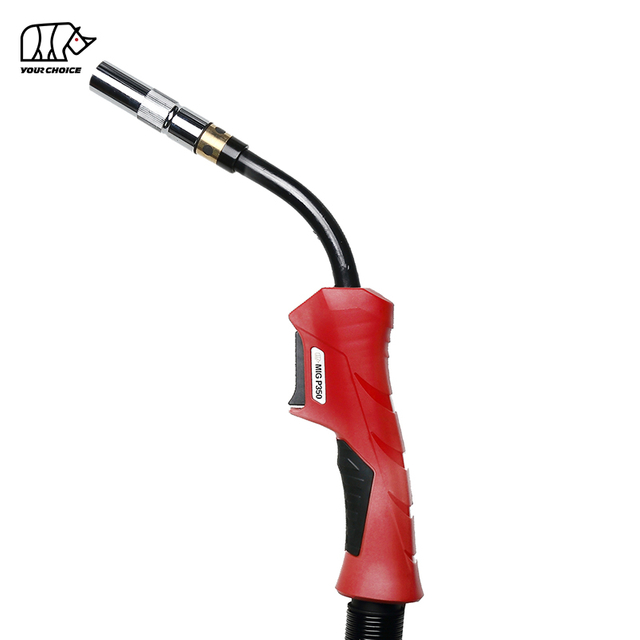
The integration of robotic automation in welding operations has fundamentally reshaped modern manufacturing floors. From high-volume automotive assembly lines to precise aerospace component fabrication, the robotic arm is only as effective as the end-of-arm tooling it carries. At the heart of this system lies the robotic MIG welding torch, a component often subjected to extreme thermal loads, mechanical stress, and electrical demands. While many components in a robotic cell receive daily attention, the welding torch remains the primary interface between the machine and the metal, dictating both weld quality and overall equipment effectiveness.
This guide explores the practical applications, operational challenges, and optimization strategies for robotic air-cooled MIG welding torches in industrial environments. Using the INWELT ROBOT 350D 350A Air-Cooled Torch as a reference model for modern design principles, we will delve into the scenarios where robotic welding excels and how to solve common issues that arise during high-duty-cycle operations.
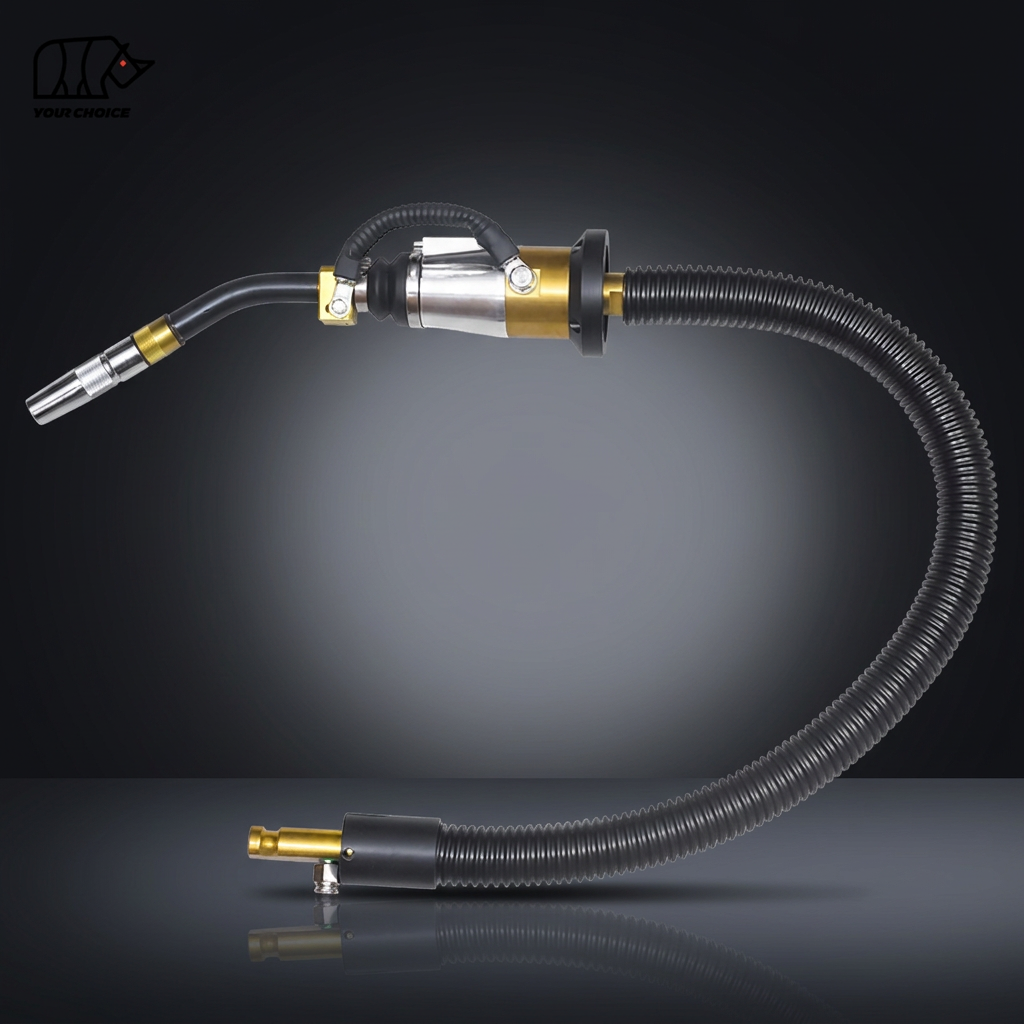
The Anatomy of a Robotic Welding Torch: Understanding the Workhorse
Before examining application scenarios, it is essential to understand the engineering that allows a robotic torch to perform thousands of identical welds without deviation. Unlike manual welding guns, robotic torches are designed for specific mounting patterns, collision detection systems, and consistent wire feed alignment.
The Significance of Air-Cooled Systems in Robotic Applications
Robotic torches generally fall into two categories: water-cooled and air-cooled. The choice between the two significantly impacts cell design and operational cost.
Air-cooled torches, such as the model with a 350A rating, utilize the ambient air and the flow of shielding gas to dissipate heat generated by the welding arc and electrical resistance. This design eliminates the need for a water cooler, radiator, pumps, and additional plumbing. The primary benefit in a robotic context is system simplification and reduced footprint. A robotic cell operating with an air-cooled torch has fewer potential points of failure—no coolant leaks to contaminate the weld zone and no pump maintenance intervals to schedule.
However, this simplicity comes with thermal management constraints. An air-cooled torch typically has a lower duty cycle at maximum amperage compared to a water-cooled equivalent. For the 350A class torch, this is often defined as a 60% duty cycle at 350 amps using mixed gases. In practical terms, this means the torch is perfectly suited for a vast majority of robotic applications involving mild steel and stainless steel up to moderate thicknesses, provided the arc-on time is balanced with appropriate cooling periods.
The Replaceable Neck Advantage in Automated Cells
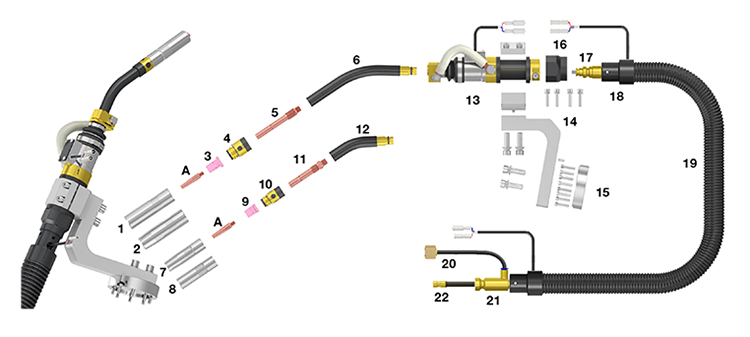
Robotic welding torches inevitably collide with fixtures, spatter build-up, or undergo wear in the neck region due to repetitive motion stress. Historically, a bent neck meant replacing the entire torch body—a costly and time-consuming process requiring extensive reprogramming of the Tool Center Point.
The design of modern torches featuring a replaceable neck addresses this critical pain point. In the context of the INWELT ROBOT 350D, the replaceable neck system allows maintenance personnel to:
Restore Original Tool Center Point Accuracy: By using precision-manufactured replacement necks, the robot can resume welding with minimal or zero re-touch of programmed points. This reduces downtime from hours to minutes.
Adapt to Different Access Angles: A single torch body can be fitted with necks of varying angles (22°, 45°, or custom bends) to suit different part geometries without changing the entire cable assembly.
Mitigate Collision Damage: The neck acts as a mechanical fuse. In a severe crash, the neck deforms, saving the more expensive torch body and robot wrist from structural damage.
Core Application Scenarios for Robotic Air-Cooled Torches
Robotic welding is not a one-size-fits-all solution. The effectiveness of a specific torch model is maximized when matched correctly to the production environment. The following scenarios represent the most productive use cases for a 350A air-cooled robotic MIG torch.
High-Volume Automotive and Tier 1 Supplier Production
The automotive sector remains the largest consumer of robotic welding technology. In this environment, the parts are often stamped sheet metal ranging from 0.8mm to 3.0mm in thickness.
The Challenge: The robotic cell must perform hundreds of short, overlapping stitch welds or continuous seams per hour. The environment is characterized by high ambient temperatures and potential interference from adjacent robots.
The Solution with Air-Cooled Torch Integration:
In this scenario, an air-cooled torch is often the preferred tool due to the short arc-on times inherent in automotive spot and stitch welding. The duty cycle of an air-cooled 350A torch is rarely exceeded because the robot spends a significant portion of its cycle moving between welds (air-cutting time), allowing the torch neck and handle to cool passively. The compact, lightweight nature of the torch body reduces the inertia on the robot's 6th axis, enabling higher acceleration and deceleration rates, which directly contributes to reduced takt time.
Furthermore, the replaceable neck is a critical asset here. In the event of a tip touch or minor crash against a misloaded stamping, the operator can swap the neck and replace the contact tip during the next scheduled line stop, avoiding the catastrophic line downtime associated with sending the robot in for a complete recalibration.
Fabrication of Agricultural and Construction Equipment
This sector is defined by thicker materials—often ranging from 4.0mm to 12.0mm mild steel—and longer, continuous welds. Parts include chassis frames, loader arms, and heavy brackets.
Managing Heat Build-up During Long Seams:
While water-cooled torches are often specified for 500A+ applications in heavy fab, the 350A air-cooled class fills a specific niche here: robotic welding of secondary assemblies and non-structural components.
When using an air-cooled torch for a 10mm fillet weld running at 320 amps, the operator must be mindful of thermal soak. The INWELT ROBOT 350D torch body is engineered with optimized internal gas flow paths that assist in convective cooling of the power cable and neck. To ensure consistent weld quality in these scenarios, programmers should implement the following techniques:
Torch Cleaning Cycles: Program the robot to visit a reamer station every 10-15 arc minutes to remove spatter build-up. A clean nozzle allows the shielding gas to flow laminarly and cools the front end more efficiently.
Staggered Welding Sequence: Instead of welding all seams in one localized area, sequence the robot to move to the opposite end of the large part. This allows one section of the torch to cool while the arc is active elsewhere.
General Industry and Job Shop Automation
Job shops present a unique environment where the robot may run production for one part for four hours, then switch to a completely different fixture and weld procedure for the next shift.
Flexibility and Quick Changeover:
The ability to quickly change the torch configuration is paramount. The replaceable neck system allows a job shop to maintain an inventory of necks with different bend angles. A 45-degree neck might be ideal for welding inside a tight corner of a cabinet, while a 22-degree neck is better for flat lap joints. Changing the neck is a simple mechanical operation that does not require the specialized labor of a robot programmer. This reduces the Mean Time To Repair and increases the Overall Equipment Effectiveness of the robotic cell.
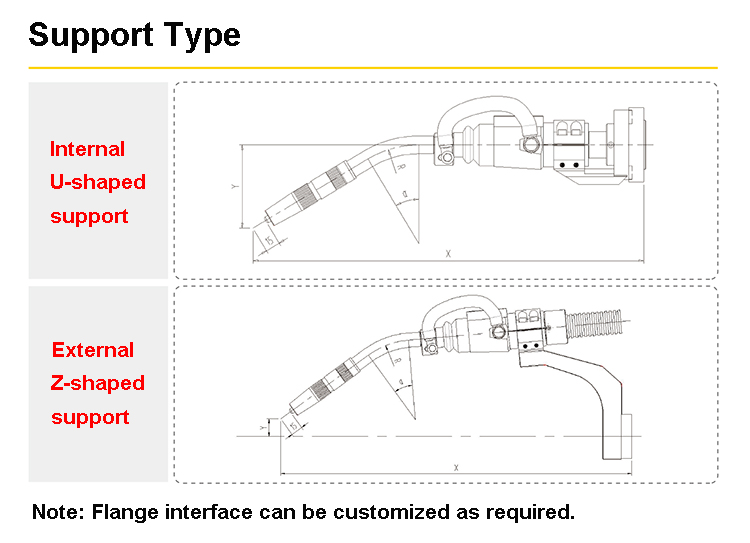
Troubleshooting Common Issues in Robotic MIG Torch Operation
Even with optimal application matching, robotic welding torches face unique challenges due to their relentless duty cycles. Understanding the root cause of common failures allows for proactive rather than reactive maintenance.
Issue 1: Premature Contact Tip Failure and Burn-Backs
The contact tip is the consumable component that transfers welding current to the wire. In a robotic setting, tips fail faster than in manual welding due to higher wire feed speeds and continuous use.
Symptoms: Wire burning back and fusing to the tip, erratic arc starts, or "machine gun" feeding sounds.
Root Causes Related to Torch Setup:
Misalignment in the Neck: If the replaceable neck is slightly bent (even imperceptibly) or the insulator is worn, the wire enters the contact tip at an angle. This causes uneven electrical contact and localized overheating of the tip.
Thermal Expansion: At 300+ amps, the copper alloy tip expands. If the tip was not properly tightened when cold, the connection loosens under heat, increasing electrical resistance and heat generation.
Solution Protocol:
Inspect the neck straightness using a simple bench fixture. Replace the neck if out of tolerance.
Ensure the use of the correct diffuser and collet body for the specific wire diameter. A worn collet will allow the wire to wobble, destroying the tip bore.
Verify the wire feed alignment through the torch lead. Sharp bends in the cable pack near the robot wrist create feed resistance, exacerbating tip wear.
Issue 2: Porosity and Inadequate Gas Coverage
Robotic welds are often visually inspected by laser sensors or cameras. Porosity is an immediate cause for part rejection.
The Air-Cooled Torch Factor:
Unlike a water-cooled torch where the cooling liquid keeps the gas nozzle relatively cold, an air-cooled torch nozzle can become extremely hot during high-duty cycles. Hot metal attracts spatter. As spatter accumulates on the inside bore of the nozzle, it disrupts the smooth laminar flow of shielding gas, drawing atmospheric nitrogen and oxygen into the weld puddle.
Preventative Maintenance Strategy:
Nozzle Cleaning Station Programming: Do not rely on the robot's crash detection to clean the nozzle. Proactively program the robot to dip the torch in anti-spatter compound and spin the reamer before the weld quality degrades.
Gas Flow Optimization: A common mistake is using excessive gas flow to compensate for a dirty nozzle. This creates turbulence (Venturi effect) that pulls more air into the shield. For a robotic MIG torch, a flow rate of 30-40 cubic feet per hour is typically sufficient when the nozzle is clean.
Issue 3: Overheating of the Torch Body and Handle
While the neck is designed to handle the arc heat, the torch body houses the power cable connections.
Identifying Thermal Overload:
If the rubber handle or the quick-connect coupling becomes too hot to touch comfortably, the torch is operating beyond its thermal capacity. Continued operation in this state degrades the insulation of the internal power cable, leading to eventual phase-to-phase short circuits within the torch body.
Optimizing Duty Cycle with Air-Cooled Equipment:
For a 350A air-cooled torch, the duty cycle curve is not just a specification; it is a programming constraint. If the robot consistently requires more than 6 minutes of continuous welding per 10-minute period at maximum amperage, consider the following adjustments:
Increase Wire Stick-Out: Slightly increasing the contact-tip-to-work distance increases the electrical resistance of the wire, which reduces the actual welding current while maintaining wire feed speed. This subtle change can lower the thermal load on the torch by 10-15%.
Pulse Welding Transfer Modes: Utilizing pulsed MIG reduces the average current required to achieve a given deposition rate compared to standard spray transfer. Lower average current means less resistive heating in the torch power cable.
Best Practices for Extending Torch Life in Demanding Environments
The long-term cost of ownership for a robotic welding torch is determined less by the purchase price and more by the frequency of replacement and the labor cost of re-teaching points. Implementing the following maintenance and handling protocols ensures maximum uptime.
Implementing a Preventative Maintenance Schedule for the Torch Neck
The replaceable neck is a consumable assembly, not a permanent fixture. A structured replacement schedule prevents unexpected failures during production.
Visual Inspection Checklist (Daily):
Neck Insulator Condition: Look for black carbon tracking or cracking. This indicates arcing between the neck and the gas nozzle, which erodes the neck threads.
Nozzle Spring Tension: Ensure the gas nozzle seats firmly. A loose nozzle vibrates under robot motion, causing the arc to wander.
Mechanical Inspection (Weekly):
Handle/Torch Body Connection: Check the torque on the connection nut securing the neck to the handle. Vibration from the robot can loosen this critical electrical connection.
Wire Conduit Drag Test: Disconnect the neck and manually feed wire through the cable. Excess drag indicates a worn or kinked liner that puts stress on the wire feeder and reduces neck life.
The Critical Role of Tool Center Point Verification
One of the most significant hidden costs in robotic welding is the downtime associated with Tool Center Point re-teaching.
The Replaceable Neck Solution:
The value proposition of the INWELT ROBOT 350D's replaceable neck is its dimensional repeatability. High-precision manufacturing ensures that when Neck A is replaced with an identical Neck B, the deviation of the weld wire tip is less than 0.5mm. This level of precision allows the robot programmer to perform a simple Touch Sensing routine or even resume welding without any correction on non-critical seams.
Procedure for Neck Replacement:
Power down the robot and lock out the welding power source.
Remove the gas nozzle and contact tip assembly.
Loosen the neck retaining nut and pull the neck free from the torch body.
Do not rotate the cable pack or torch mount.
Insert the new neck, ensuring the alignment key is seated correctly in the torch body.
Reassemble consumables and verify gas flow.
Run a test weld on scrap material to confirm arc characteristics before resuming production.
Future-Proofing Robotic Welding Cells
While the fundamental principles of gas metal arc welding remain constant, the environment surrounding the robotic torch is evolving. Integration of IIoT (Industrial Internet of Things) sensors and automated quality control is becoming standard.
The design of the modern air-cooled torch must accommodate these trends. The mounting interface and cable strain relief must be robust enough to handle the added weight of seam-tracking sensors or laser cameras. Furthermore, the internal geometry of the torch body must remain free of obstructions to allow for consistent gas flow required for high-speed camera monitoring.
In conclusion, the selection and management of a robotic MIG welding torch like the INWELT ROBOT 350D is a multidisciplinary task bridging welding engineering, robotics programming, and maintenance reliability. By understanding the specific application scenarios—whether it be the speed of automotive welding or the thermal management of heavy fabrication—and by leveraging design features like the replaceable neck, manufacturers can achieve superior arc-on time, lower maintenance costs, and consistent, high-quality weld output. The robotic arm provides the motion and the path; the torch provides the performance that determines the final quality of the metal joint. Treating the torch as a precision instrument rather than a commodity consumable is the key to unlocking the full potential of any automated welding investment.
 English
 简体中文
简体中文 العربية
 Français
 Русский
 Español
 Português
 Deutsch
 italiano
 日本語
日本語 한국어
한국어 Nederlands
 Tiếng Việt
 ไทย
ไทย Polski
 Türkçe
 ភាសាខ្មែរ
 Bahasa Melayu
 Filipino
 Bahasa Indonesia
 magyar
 Română
 Čeština
 Монгол
 қазақ
қазақ Српски
 हिन्दी
 فارسی
فارسی Slovenčina
 Slovenščina
 Norsk
Norsk Svenska
 українська
 Ελληνικά
 Suomi
Suomi Latine
 Dansk
Dansk বাংলা
বাংলা Hrvatski
 Afrikaans
 Gaeilge
 Eesti keel
 नेपाली
 Oʻzbekcha
 latviešu
 Azərbaycan dili
 Беларуская мова
 Bosanski
 Български
 ქართული
 Lietuvių