In the world of metal fabrication, TIG (Tungsten Inert Gas) welding—often referred to as Argon Arc Welding—stands as the pinnacle of precision and aesthetic beauty. Unlike other welding processes that prioritize speed and deposition, TIG welding is defined by its control, cleanliness, and the visually stunning results it produces. For industries ranging from aerospace to high-end food processing, the visual quality of a weld is not just a matter of pride; it is a critical indicator of structural integrity and metallurgical purity.
This guide delves deep into the visual characteristics of high-quality TIG welding, exploring how material types, gas shielding, and operator technique converge to create the perfect weld.
The Aesthetics of Strength: Why Visual Quality Matters in TIG Welding
Visual inspection is the first line of defense in quality control. In Argon Arc Welding, the appearance of the bead tells a story of the thermal history of the joint. A "perfect" weld is more than just a straight line; it is a testament to the welder’s ability to balance heat input with filler metal addition while maintaining a pristine shield of inert gas.
The "Stacked Dimes" Phenomenon
The most iconic visual trait of TIG welding is the "stacked dimes" appearance. This refers to the uniform, overlapping ripples created by the rhythmic dipping of the filler rod into the weld pool. Consistency in these ripples indicates a steady travel speed and a mastered "pulse" in manual feeding, which ensures even penetration throughout the joint.
Heat Tints and Coloration
On materials like stainless steel and titanium, the color of the weld and the heat-affected zone (HAZ) is a primary indicator of gas coverage. While a rainbow of colors may look attractive, it actually represents different levels of oxidation. Achieving a "straw" or "chrome" finish signifies optimal protection, whereas deep blues or purples suggest higher temperatures or slight gas turbulence.
Stainless Steel TIG Welding: Mastering the Rainbow
Stainless steel is perhaps the most common material associated with high-quality Argon Arc Welding. Due to its low thermal conductivity and high sensitivity to oxygen, the visual results on stainless steel are highly dependent on the welder's ability to manage the "puddle."
Achieving the Silver and Gold Standard
When welding 304 or 316 stainless steel, the goal is often to keep the weld as close to the base metal color as possible. A silver or light gold bead indicates that the argon shield remained intact until the metal cooled below its reactive temperature. This is achieved through proper CFM (Cubic Feet per Hour) settings and the use of large gas lenses to provide a laminar flow of argon.
Managing the Heat-Affected Zone (HAZ)
A professional TIG weld should have a narrow HAZ. If the colored bands extend far from the weld bead, it indicates excessive heat soak. This can lead to "carbide precipitation," which compromises the corrosion resistance of the stainless steel. Visual excellence here translates directly to functional longevity.
Aluminum TIG Welding: The Quest for the Clean Bead
Aluminum presents a completely different visual challenge. Because aluminum forms a heavy oxide layer that melts at a much higher temperature than the base metal, the "cleaning action" of the AC (Alternating Current) arc is visible in the final result.
The Etched Zone (Cleaning Action)
A high-quality aluminum TIG weld will be flanked by a thin, frosted-looking strip on either side of the bead. This is the "etched" area where the cathodic cleaning of the arc has stripped away the aluminum oxide. A uniform, clean etched zone is a sign of a well-balanced AC frequency and clean base material.
Bead Profile and Wet-Out
Aluminum cools rapidly. A professional result shows a bead that has "wetted out" nicely into the toes of the joint without being too convex. If the ripples are too sharp or the bead looks "ropey," it suggests the amperage was too low or the travel speed was too fast for the material's thickness.
Technical Quick-Reference: TIG Welding Parameters by Material
To achieve the professional results discussed in this guide, matching your machine settings to the specific properties of the metal is essential. Use this table as a starting point for your next project.
Material Type
Current Type (Polarity)
Tungsten Tip Geometry
Shielding Gas Flow (CFH / LPM)
Recommended Tungsten Electrode
Stainless Steel
DCEN (DC-)
Sharp Point (30-60°)
15-20 CFH / 7-10 LPM
2% Lanthanated (Blue)
Aluminum
AC (Alternating)
Balled or Slightly Truncated
20-25 CFH / 10-12 LPM
Pure (Green) or Zirconiated
Titanium
DCEN (DC-)
Very Sharp (Long Taper)
25-30 CFH (Use Trailing Shield)
2% Lanthanated or Thoriated
Mild Steel
DCEN (DC-)
Sharp Point
15-18 CFH / 7-9 LPM
2% Thoriated (Red)
Copper Alloys
DCEN (DC-)
Sharp Point
20-25 CFH
2% Lanthanated
Note: These values are for standard thicknesses (approx. 3mm). Always adjust your amperage based on the specific joint configuration and travel speed.
Technical Factors That Define Visual Success
Achieving the results shown in professional galleries requires a mastery of several technical variables. In Argon Arc Welding, every adjustment on the machine manifests visually in the weld.
The Role of the Gas Lens
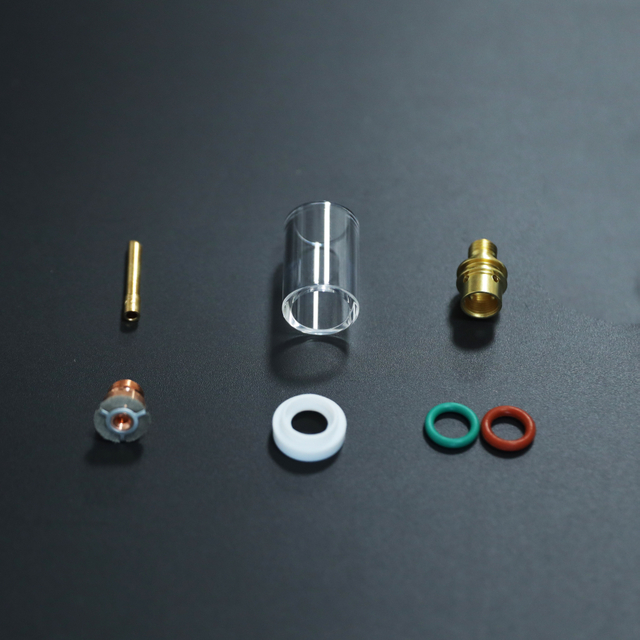
One of the "secrets" to the cleanest TIG beads is the gas lens. Unlike a standard collet body, a gas lens uses a series of fine meshes to straighten the argon flow. Visually, this results in a much clearer weld pool and the ability to extend the tungsten further for better visibility in tight joints without losing gas coverage.
Pulse Settings and Their Visual Impact
Modern TIG power sources allow for high-speed pulsing. Visually, pulsing constricts the arc, creating a narrower bead and a more pronounced ripple pattern. This is particularly useful on thin gauge materials where heat control is paramount to prevent warping or burn-through.
Tungsten Geometry and Prep
The shape of the tungsten electrode determines the shape of the arc cone. A sharp point produces a narrow, deep-penetrating arc, while a blunter end spreads the heat. For visual consistency, the grind marks on the tungsten must run lengthwise; cross-grinding causes arc wander, which leads to jagged, uneven weld beads.
Identifying and Correcting Visual Defects
Even a visually "good" weld can have hidden flaws. Understanding what a bad weld looks like is essential for reaching the next level of craftsmanship.
Porosity: The Silent Beauty Killer
Porosity appears as small holes or pits on the surface or inside the bead. It is usually caused by atmospheric contamination—often a breeze blowing away the argon shield or a leak in the torch lines. Visually, porosity makes a weld look "dirty" and gray, signaling a complete lack of structural integrity.
Undercut and Overlap
Undercut is a groove melted into the base metal at the toe of the weld that isn't filled by filler metal. It creates a stress riser. Overlap (or "cold lap") is the opposite, where the weld metal sits on top of the base metal without fusing. Both are signs of incorrect torch angle or improper travel speed.
Post-Weld Presentation: Beyond the Arc
A professional TIG welding display doesn't end when the arc stops. How the piece is handled afterward contributes to its "showroom" quality.
The Importance of Back-Purging
For pipe and tube welding, the visual quality inside the pipe is as important as the outside. "Sugaring" (oxidation on the backside) is a common failure. Using a back-purge of argon ensures the inside of the weld is as smooth and clean as the top, which is vital for sanitary or high-pressure applications.
Chemical Cleaning vs. Mechanical Polishing
To preserve the natural beauty of a TIG weld, many professionals use electrochemical cleaning rather than grinding. This removes the heat tint while leaving the delicate ripple pattern intact, highlighting the skill involved in the welding process.
Conclusion: The Signature of a Master Craftsman
Argon Arc Welding is more than a joining process; it is a signature of quality. When a client or inspector looks at a TIG weld, they are looking for symmetry, consistency, and purity. By mastering the variables of gas flow, heat management, and material-specific techniques, fabricators can produce results that are not only structurally sound but also visually extraordinary.
As you continue to refine your TIG welding process, remember that every bead is a reflection of your attention to detail. Whether it is the silver glint of a stainless steel joint or the frosted cleaning action on a heavy aluminum plate, visual excellence in TIG welding is the ultimate hallmark of a professional operation.
TIG Welding Q&A: Troubleshooting Professional Results
Below are the most frequently asked questions regarding the visual and structural quality of Argon Arc Welding. Understanding these common "pain points" will help you troubleshoot your process and improve your consistency.
Why is my TIG weld turning black or dark grey instead of silver?
This is the most common visual defect in TIG welding, known as oxidation. It occurs when the hot weld metal reacts with oxygen in the air before it has cooled sufficiently.
The Fix: Increase your post-flow time (the gas that flows after the arc stops). Also, check for gas leaks in your torch lines and ensure you are using a gas lens to provide better, laminar coverage. If the metal is "burnt" throughout, you may be using too much amperage or moving too slowly.
What are the benefits of using High-Frequency (HF) Pulse TIG?
Pulse TIG allows the machine to cycle between a high peak current and a lower background current.
Visual Benefit: It creates a very defined, clean ripple pattern (the "stacked dimes") and constricts the arc, making the bead narrower.
Technical Benefit: It significantly reduces the overall heat input, which is critical for preventing warping in thin materials and preserving the corrosion resistance of stainless steel.
When should I switch from a standard collet body to a Gas Lens?
You should use a gas lens whenever you require the highest possible visual quality.
The Reason: A standard collet body creates turbulent gas flow, which can pull in atmospheric air. A gas lens uses fine screens to create a "laminar" (smooth) flow. This allows you to extend the tungsten electrode further out of the cup for better visibility while still maintaining a perfect argon shield.
Why am I getting "pepper" (black spots) in my aluminum weld pool?
This is usually caused by contamination. Aluminum is highly sensitive to dirt, grease, and its own oxide layer.
The Fix: Ensure you are using "AC Balance" correctly to provide enough cleaning action. Also, verify that you cleaned the base metal with a dedicated stainless steel wire brush (used only for aluminum) and wiped it down with acetone before welding.
Does the "Stacked Dimes" look actually mean the weld is stronger?
Not necessarily, but it is a strong indicator of process control.
The Reality: While a smooth, non-rippled weld can also be strong, the "stacked dimes" pattern shows that the welder maintained a consistent travel speed and filler metal addition. Consistency in appearance usually translates to consistency in penetration and metallurgical properties throughout the entire joint.
This website uses cookies and similar technologies (“cookies”). Subject to your consent, will use analytical cookies to track which content interests you, and marketing cookies to display interest-based advertising. We use third-party providers for these measures, who may also use the data for their own purposes.
You give your consent by clicking "Accept all" or by applying your individual settings. Your data may then also be processed in third countries outside the EU, such as the US, which do not have a corresponding level of data protection and where, in particular, access by local authorities may not be effectively prevented. You can revoke your consent with immediate effect at any time. If you click on "Reject all", only strictly necessary cookies will be used.
 English
 简体中文
简体中文 العربية
 Français
 Русский
 Español
 Português
 Deutsch
 italiano
 日本語
日本語 한국어
한국어 Nederlands
 Tiếng Việt
 ไทย
ไทย Polski
 Türkçe
 ភាសាខ្មែរ
 Bahasa Melayu
 Filipino
 Bahasa Indonesia
 magyar
 Română
 Čeština
 Монгол
 қазақ
қазақ Српски
 हिन्दी
 فارسی
فارسی Slovenčina
 Slovenščina
 Norsk
Norsk Svenska
 українська
 Ελληνικά
 Suomi
Suomi Latine
 Dansk
Dansk বাংলা
বাংলা Hrvatski
 Afrikaans
 Gaeilge
 Eesti keel
 नेपाली
 Oʻzbekcha
 latviešu
 Azərbaycan dili
 Беларуская мова
 Bosanski
 Български
 ქართული
 Lietuvių