INWELT Pana MIG Welding Contact Tips — Precision Copper Alloy Consumables for P180, P350, and P500 Torches
The MIG welding contact tip is the final electrical junction in the torch assembly before current reaches the weld wire, and it is the last physical component the wire touches before entering the arc. Every weld bead, every arc start, and every production cycle depends on the contact tip doing its job with repeatable precision. Yet under the intense heat of the arc and the constant friction of wire feeding, contact tips are among the most rapidly consumed components in any MIG welding operation. INWELT manufactures Pana-style MIG contact tips in both E-Cu (electrolytic copper) and CuCrZr (copper-chromium-zirconium) alloys, covering the full range of wire diameters and torch platforms from light fabrication on the P180 to heavy structural work on the P500. Every tip is machined to exacting dimensional standards, delivering the electrical conductivity, heat dissipation, and wire feed consistency that professional welders, fabrication shops, and industrial procurement managers rely on for clean, high-quality welds at production speed.
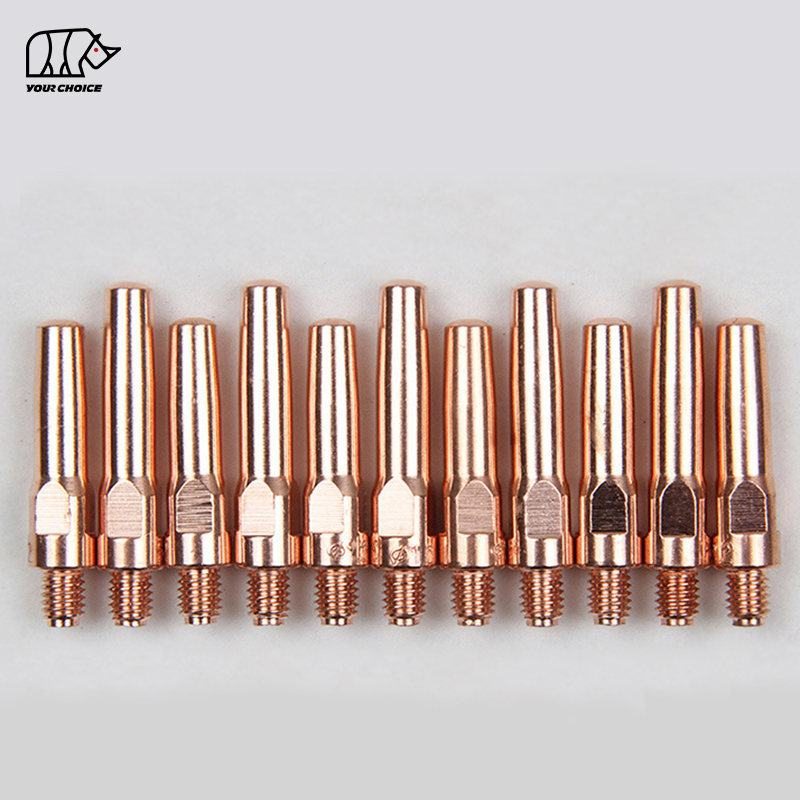
The MIG Contact Tip — Where Electricity Meets the Weld Wire
Understanding the contact tip's dual role in the MIG welding circuit is essential for recognizing why tip condition matters so much and why quality manufacturing makes a measurable difference in daily production.
The Electrical Transfer Point
The contact tip is the component that transfers welding current from the MIG gun to the weld wire as the wire passes through it during welding. This is the final electrical junction in the torch assembly before the arc is established. Any resistance, corrosion, or dimensional irregularity at this point translates directly into arc instability, excessive spatter, and inconsistent wire feed. A precisely machined contact tip with a smooth, round bore ensures that the wire maintains consistent electrical contact throughout its travel, resulting in stable arc characteristics and uniform weld bead profiles.
Wire Guidance and Alignment
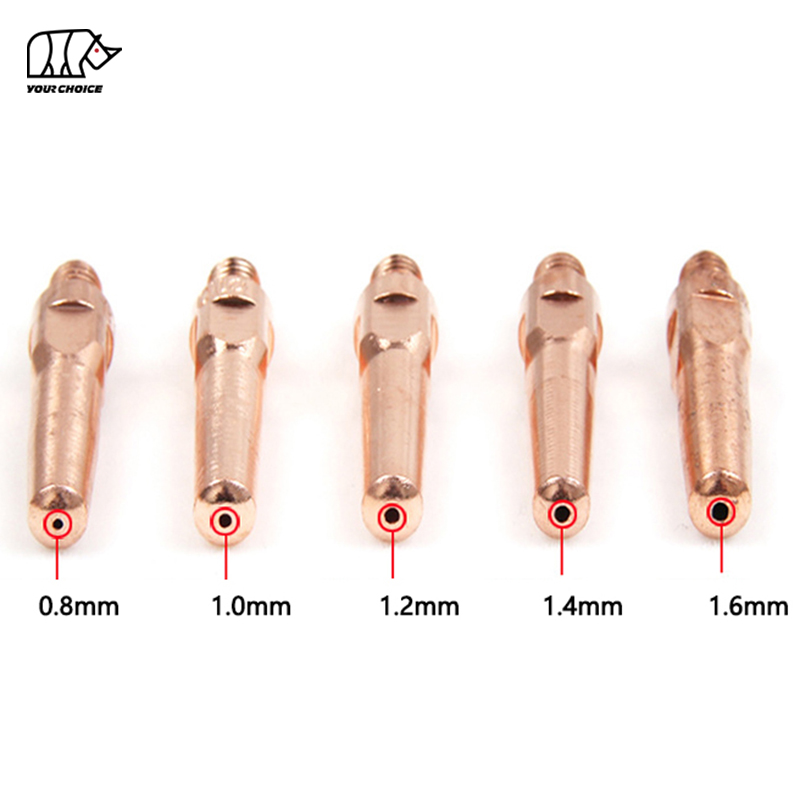
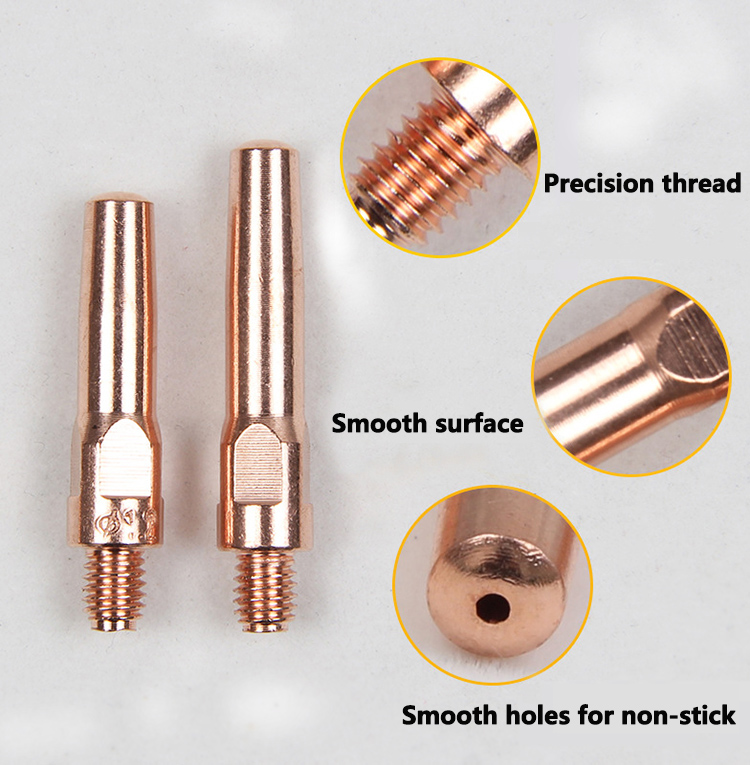
Beyond electrical transfer, the contact tip guides the weld wire along its final few millimeters of travel before it enters the arc. The bore must be perfectly concentric with the diffuser and the nozzle, because any deviation alters the wire's trajectory and changes contact-tip-to-work distance — a variable that welders depend on remaining constant pass after pass. MIG contact tips for Pana MIG welding torches come made to fit welding wire typically from 0.6mm to 1.6mm, referencing metric sizes such as 0.8mm, 1.0mm, 1.2mm, and 1.6mm.
The Wear Component Dilemma
Contact tips are consumable by design, but their lifespan varies dramatically depending on material choice. Tips made of alloys with better high-temperature properties resist softening, deformation, and bore enlargement far longer than standard copper tips, particularly during high-amperage welding or extended arc-on times. Selecting the right tip for the application — matching the material to the thermal demands of the job — is one of the most cost-effective decisions a welding supervisor can make. A cheaper tip that must be replaced three times as often costs more in downtime alone than a premium tip that lasts through the full shift.
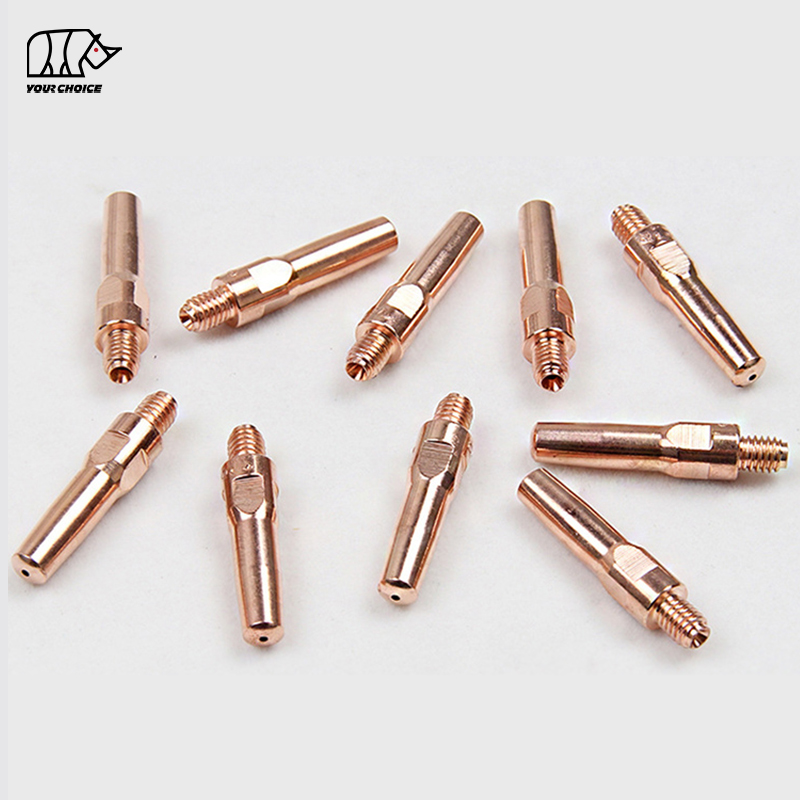
Material Selection — E-Cu Electrolytic Copper vs. CuCrZr Copper-Chromium-Zirconium Alloy
One of the most impactful decisions in MIG consumables procurement is the choice between standard electrolytic copper and advanced copper-chromium-zirconium alloy for contact tips. INWELT manufactures Pana contact tips in both materials, because each has its place across different welding applications, amperage ranges, and production environments.
E-Cu (Electrolytic Copper) — Proven Reliability for Standard-Duty Applications
E-Cu (electrolytic copper) is the most economical and widely used material for contact tips. With a Vickers hardness of approximately 110–115 HV and a softening point from 250°C, E-Cu provides good electrical conductivity and adequate mechanical durability for light to medium-duty welding applications. E-Cu tips perform well on the P180 torch platform and on P350 torches running at moderate duty cycles, where the thermal load does not push the material beyond its softening point. For general fabrication shops, automotive repair, and workshop environments where amperages stay within the standard range, E-Cu tips represent a practical and cost-effective choice.
CuCrZr (Copper-Chromium-Zirconium) — Engineered Superiority for High-Temperature, High-Duty-Cycle Work
CuCrZr (copper-chromium-zirconium) is a high-performance copper alloy specifically developed for welding consumables exposed to sustained high temperatures. CuCrZr contact tips bring excellent performance advantages compared to standard E-Cu tips. The electrical conductivity of CuCrZr alloy is superior, so the arc transfer encounters less resistance and the contact tip wears out less rapidly. Critically, CuCrZr maintains its hardness at elevated temperatures — up to 500°C and, in some formulations, up to 700°C — offering significantly better wear resistance than standard copper tips at the elevated temperatures generated during high-amperage and high-duty-cycle welding. CuCrZr tips have been adopted across the industry to increase hardness and help extend tip life, and their performance advantage is most pronounced in conditions where arc-on time is extended: robotic applications, automated welding cells, structural steel fabrication, heavy equipment manufacturing, and any production environment running the P500 torch at 500 amps with high duty cycles.
Making the Right Material Choice
There is no universally correct answer — each material serves its purpose. E-Cu contact tips deliver reliable performance at an economical price point for standard-duty work. CuCrZr contact tips provide superior thermal endurance and extended service life for demanding applications. The key is matching the tip material to the specific welding operation: E-Cu for P180 torches and light-duty P350 work, CuCrZr for heavy-duty P350 applications, the P500 platform, and any automated or robotic welding system where consistent tip life directly impacts cell uptime and production throughput.
Pana Torch Series Compatibility and Dimension Reference
INWELT Pana MIG contact tips are manufactured to standard industry dimensions for direct compatibility with the P180, P350, and P500 torch platforms. The following tables provide the key dimensional references for each torch series.
P180 Contact Tip Dimensions
The P180 series tips are designed for light to medium-duty fabrication with wire diameters from 0.8mm to 1.2mm, fitting the M6 threaded diffuser common to the P180 torch platform. Bore diameters increase proportionally with wire size to ensure smooth wire passage and consistent electrical contact without binding or excessive clearance.
P350 Contact Tip Dimensions
The P350 series tips are the workhorse of medium to heavy fabrication, compatible with the P350 torch rated at 340 amps at 60% duty cycle. Available in E-Cu for standard-duty work and CuCrZr for extended service life under sustained thermal loading, these tips cover wire sizes from 0.8mm through 1.6mm.
P500 Contact Tip Dimensions
The P500 series tips are built for heavy industrial applications at 500 amps and 60% duty cycle. CuCrZr alloy is strongly recommended for this platform due to the intense thermal demands of sustained high-amperage welding. Wire sizes up to 1.6mm are available to support high-deposition spray transfer and flux-cored welding processes.
Wire Size Selection Guide
Selecting the correct contact tip bore diameter for the weld wire diameter is not merely a recommendation — it is essential for arc stability, wire feed consistency, and the elimination of electrical arcing between the wire and the tip bore.
The Bore-to-Wire Relationship
The contact tip bore must be precisely matched to the wire diameter being used. An undersized bore causes wire binding, erratic feed, and excessive friction that accelerates tip wear. An oversized bore allows the wire to wander, resulting in intermittent electrical contact, micro-arcing inside the tip bore, and inconsistent arc characteristics. INWELT Pana contact tips are machined with bore tolerances specifically calibrated for each wire diameter, ensuring the wire maintains continuous, stable electrical contact while feeding smoothly without binding.
Quick-Reference Wire Size Compatibility
INWELT Pana contact tips are available for the following wire diameters, with each size clearly marked for instant identification:
Matching the wire diameter to the contact tip marked for that same diameter is an inviolable rule of MIG welding — using a tip labeled for 1.2mm wire with 1.0mm wire, or vice versa, will produce immediate arc quality problems that cannot be corrected by adjusting any other welding parameter.
Installation, Maintenance, and Replacement
Contact tip service life is determined not only by material quality but by correct installation procedures and timely replacement before worn tips cause weld defects.
Correct Installation Procedure
Thread the contact tip securely into the gas diffuser by hand or with the appropriate MIG pliers tool. The tip must be tightened sufficiently to ensure solid electrical contact with the gas diffuser — a loose tip creates resistance heating that accelerates wear and degrades arc stability. However, overtightening can strip the M6 threads or distort the tip body, compromising bore concentricity. The objective is firm, secure engagement without excessive torque. Always verify tip tightness during routine nozzle cleaning and wire spool changes.
Recognizing Contact Tip Wear
Contact tips should be replaced when any of the following indicators appear: the bore becomes visibly enlarged or oval compared to a new tip of the same specification; wire feed becomes inconsistent or the wire hangs up intermittently during feeding; arc starts become erratic, with the arc wandering or sputtering where it previously ran smoothly; burn-back damage is present on the tip face; or the tip body shows discoloration indicating that the material's softening temperature has been exceeded. A worn tip is not a harmless inconvenience — it is a direct source of arc instability, excessive spatter, porosity, and eventual weld defects that will require rework.
Preventive Replacement Strategy
For critical welds on structural or code-quality work, scheduled preventive tip replacement is a low-cost protective measure that eliminates contact tip wear as a variable in weld quality control. In production environments, keeping spare contact tips organized by wire size and material type ensures that a damaged or worn tip can be replaced in seconds rather than causing the welder to continue operating with a compromised consumable. Experienced supervisors know that the cost of a replacement tip is measured in cents, while the cost of reworking a failed weld is measured in hours of labor.
Real-World Applications Across Industries
INWELT Pana MIG contact tips are deployed daily in demanding industrial environments where weld quality and production uptime are directly linked to consumable reliability.
Structural Steel Fabrication: P350 and P500 torches with CuCrZr contact tips support continuous high-deposition welding of bridge beams, columns, and heavy structural assemblies where arc stability must be maintained hour after hour and electrode stick-out consistency is critical for meeting structural code requirements.
Heavy Equipment and Machinery Manufacturing: High-duty-cycle welding of excavator booms, crane structures, mining equipment frames, and agricultural machinery places sustained thermal demands on contact tips. CuCrZr alloy tips on the P500 platform deliver the extended service life these applications require.
Shipbuilding and Marine Repair: P500 torches fitted with INWELT CuCrZr contact tips handle hull plate welding and stiffener installation in shipyard environments where wire feed consistency and arc stability must be maintained against challenging environmental conditions and extended welding cycles.
Automotive and Light Fabrication: P180 torches with E-Cu contact tips provide the precise arc control and wire feed consistency needed for sheet metal welding, exhaust system fabrication, and repair work where clean weld appearance is a priority.
Automated and Robotic Welding Cells: The dimensional consistency and extended service life of CuCrZr contact tips are particularly valuable in robotic MIG applications, where tip changes represent downtime events that interrupt production. The reduced replacement frequency directly contributes to higher overall equipment effectiveness (OEE).
Why Source Pana MIG Contact Tips from INWELT Welding Technology Co., Ltd.
Proven Manufacturing Expertise
INWELT is a direct manufacturer of welding consumables, controlling every stage of the production process from raw copper alloy selection through precision CNC machining to final dimensional inspection, packaging, and labeling. This vertical integration ensures batch-to-batch consistency that trading intermediaries cannot provide. As a leading manufacturer with over 15 years of expertise, INWELT provides premium welding consumables designed to meet the needs of professionals across industries.
Certified Quality Systems
All INWELT Pana MIG contact tips are manufactured under an ISO 9001-certified quality management system with CE and RoHS compliance as standard. Every production batch undergoes bore diameter verification, thread-fit testing, and surface quality inspection before release. Consistent dimensional accuracy is maintained through documented process controls and statistical sampling across every production run.
Factory-Direct Commercial Terms
By purchasing directly from the manufacturer, fabrication shops and welding distributors receive competitive factory-direct pricing on both sample and volume orders. Full OEM and ODM customization options are available, including private-label packaging, custom laser marking, and non-standard bore specifications for specialized wire diameters or torch configurations.
Free Sample Evaluation
Evaluating contact tip quality requires hands-on testing: thread engagement, bore accuracy, wire feed consistency, arc stability, and thermal endurance under real welding conditions. Product samples are available for evaluation before committing to volume orders, so the INWELT Pana contact tip can be tested in your own workshop alongside your existing consumables inventory.
Global Supply Experience
With a customer base spanning more than 30 countries, INWELT has built a reputation for consistent product quality, responsive technical consultation, and reliable delivery timelines across independent fabrication shops, heavy industrial manufacturers, and large-scale procurement operations alike.
Frequently Asked Questions
Q: What is the function of a MIG welding contact tip?
A: The contact tip transfers welding current from the MIG gun to the weld wire as the wire passes through it during welding. It is the final electrical junction in the torch assembly before the arc is established. The tip also guides the weld wire along its final travel before entering the arc, with the bore maintaining precise alignment to ensure consistent wire positioning and stable arc characteristics throughout every pass.
Q: Should I choose E-Cu or CuCrZr contact tips for my Pana MIG torch?
A: The choice depends on your welding amperage, duty cycle, and production environment. E-Cu (electrolytic copper) tips provide reliable electrical conductivity and adequate durability for P180 torches and light to medium-duty P350 applications where thermal loads do not exceed the material's softening point of approximately 250°C. CuCrZr (copper-chromium-zirconium) tips maintain their hardness at elevated temperatures up to and beyond 500°C, offering significantly extended service life in high-amperage, high-duty-cycle, robotic, and automated welding applications — particularly on the P500 platform.
Q: How do I know which wire size contact tip to select?
A: You must match the contact tip bore size precisely to your weld wire diameter. INWELT Pana tips support wire diameters from 0.6mm to 1.6mm, with standard metric sizes including 0.8mm, 1.0mm, 1.2mm, 1.4mm, and 1.6mm operating within a 180A–500A current range. The appropriate bore diameter ensures stable electrical contact during wire feeding. Never use a contact tip marked for a different wire diameter — a mismatched bore will cause either binding or poor electrical contact, and no adjustment of other welding parameters can correct the resulting arc instability.
Q: Which Pana torch models are INWELT contact tips compatible with?
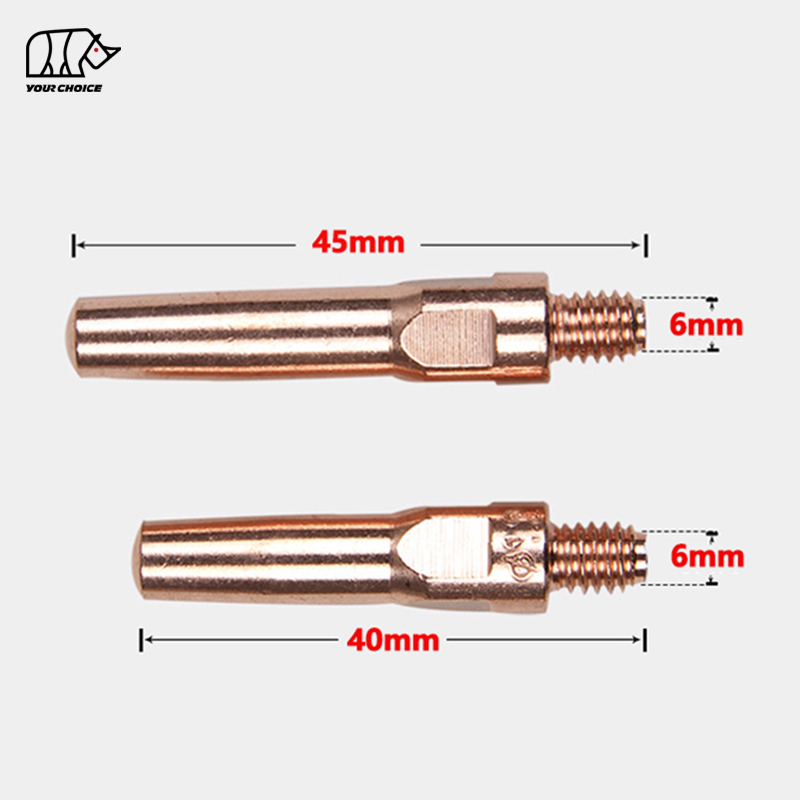
A: INWELT Pana-style contact tips are manufactured to standard industry dimensions and are compatible with P180 (200A), P350 (340A), and P500 (500A) air-cooled MIG torch platforms. These torches are among the most widely deployed MIG gun systems in fabrication, manufacturing, and heavy industrial operations worldwide. The M6 thread specification is standard across all three platforms, with specific tip lengths (28mm for P180, 40mm for P350, 45mm for P500) matched to each torch series.
Q: How often should MIG contact tips be replaced?
A: Contact tips are wear components designed for regular replacement. Inspect the tip during every nozzle cleaning and wire spool change. Replace immediately if the bore is visibly worn or oval, wire feed becomes inconsistent, arc starts show signs of instability, or the tip face shows burn-back damage. For critical code-quality work, preventive replacement on a scheduled arc-hour basis eliminates contact tip wear as a variable in weld quality control.
Q: Can a worn contact tip cause arc instability or weld defects?
A: Yes — a worn contact tip is one of the most common and easily diagnosed root causes of arc instability in MIG welding. An enlarged or oval bore allows the wire to lose consistent electrical contact, causing micro-arcing inside the tip, irregular wire feed, and excessive spatter. The resulting arc instability produces inconsistent weld bead profiles, intermittent porosity, and increased post-weld cleanup requirements. When troubleshooting unexplained arc fluctuations, inspecting and replacing the contact tip should be among the very first diagnostic steps.
Q: What is the proper way to install a MIG contact tip?
A: Insert the contact tip into the gas diffuser and tighten securely by hand or with appropriate MIG pliers to ensure firm electrical contact between the tip base and the diffuser body. The tip must be tight enough to prevent resistance heating at the connection, but excessive torque can strip M6 threads or distort the tip body and compromise bore concentricity. Always verify tightness during routine torch maintenance and after any tip change. A properly installed tip is the foundation of consistent arc performance.
Q: Are INWELT Pana contact tips compatible with original Panasonic torches?
A: Yes. INWELT Pana-style contact tips are manufactured to standard industry dimensions and are compatible with original Panasonic P180, P350, and P500 MIG torch systems, as well as aftermarket equivalents from major manufacturers that follow the same dimensional standard. The M6 thread specification and tip length dimensions are engineered for direct fitment without adaptation.
Product Specifications at a Glance
| Specification |
Detail |
| Product Name |
MIG Welding Contact Tip |
| Style |
Pana (Panasonic-compatible) |
| Brand |
INWELT |
| Material Options |
E-Cu (electrolytic copper), CuCrZr (copper-chromium-zirconium) |
| Thread Type |
M6 |
| Compatible Torch Series |
P180 (200A), P350 (340A), P500 (500A) |
| Duty Cycle Rating |
60% DC (all platforms) |
| Tip Dimensions |
M6 x 28mm (P180), M6 x 40mm (P350), M6 x 45mm (P500) |
| Available Wire Sizes |
0.6mm, 0.8mm, 0.9mm, 1.0mm, 1.2mm, 1.4mm, 1.6mm |
| Pack Quantity |
10 pieces per pack (standard packaging) |
| Welding Process |
MIG/MAG (GMAW), Flux-Cored Arc Welding (FCAW) |
| Certifications |
ISO 9001, CE, RoHS |
| Supply Mode |
OEM / ODM manufacturing available |
| Sample Availability |
Free evaluation samples available |
| Manufacturer |
Changzhou INWELT Welding Technology Co., Ltd. |
| Country of Origin |
China |
| Industry Experience |
15+ years, serving 30+ countries |
 English
 简体中文
简体中文 العربية
 Français
 Русский
 Español
 Português
 Deutsch
 italiano
 日本語
日本語 한국어
한국어 Nederlands
 Tiếng Việt
 ไทย
ไทย Polski
 Türkçe
 ភាសាខ្មែរ
 Bahasa Melayu
 Filipino
 Bahasa Indonesia
 magyar
 Română
 Čeština
 Монгол
 қазақ
қазақ Српски
 हिन्दी
 فارسی
فارسی Slovenčina
 Slovenščina
 Norsk
Norsk Svenska
 українська
 Ελληνικά
 Suomi
Suomi Latine
 Dansk
Dansk বাংলা
বাংলা Hrvatski
 Afrikaans
 Gaeilge
 Eesti keel
 नेपाली
 Oʻzbekcha
 latviešu
 Azərbaycan dili
 Беларуская мова
 Bosanski
 Български
 ქართული
 Lietuvių